Showing posts with label Train. Show all posts

Tuesday, July 21, 2015

Day 25: Taking the Train to London

After a wonderful stay in Bath, Ethan and I headed to the train station this morning.  The weather was beautiful as we left Bath and we got some lovely views of the city as the train pulled out of the station.

Sadly, the air conditioning in our car was not functioning particularly well and soon we were all baking on the way to London.  The combination of some of the warmest weather of the trip and the solid dose of humidity made for a sticky trip.


We arrived in Paddington Station, greeted by a statue of Paddington Bear.  We took the Bakerloo line straight from Padding to Waterloo, right where our hotel is located.  We had a bit of trouble figuring out how to get from the station to our hotel, as there were multiple levels of roadways around Waterloo.  Once we made it out of the right exit, our hotel was just across the street from the station.


We checked in and crashed in our room.  After a busy last night in Bath, we were both pretty tired, so we decided to take a little nap before exploring some of the area round our hotel.  We woke up a bit more rejuvenated and made our way to the banks of the Thames.

Our location is fantastic, with the riverfront just about a ten minute walk away.  We made our way through massive crowds by the London Eye as we headed towards the Westminster area.  We both thought that while the views from the London Eye would be fantastic, the waiting in line for a ticket, then waiting in line to get on the Eye, and the slow process of going around would not be worth it.  Don't think that the Eye will make it on our itinerary.


From Westminster Bridge, we had a full view of the London Eye and the promenade full of shops and cafes on the Queen's Walk.


After we had crossed the Thames we immediately came to the Palace of Westminster, the meeting place for Parliament of the United Kingdom.  The Parliament consists of the House of Commons and the House of Lords.  The Palace has been home to Parliament since the 13th century, but was a Royal residence from the 11th to 16th century.

The present building was built between 1840 and 1870 after a fire ravaged the earlier buildings.  The winner of redesigning the Palace, Charles Barry, made the new buildings in a Gothic-Revival style, specifically influenced by the English Perpendicular Gothic which is present on parts of Westminster Abbey.


The Palace is also home to probably the most famous clocktower in the world, Big Ben.  The tower, known as Elizabeth Tower since Queen Elizabeth II's Diamond Jubilee in 2012, is 315 feet high, has clock faces 23 feet in diameter, 9 foot long hour hands, and 14 foot long minute hands.  The name Big Ben comes from the nickname for the clocktower's great bell.  The first bell cast for the tower was 16 tons and took sixteen horses to pull to the base of the tower.  Unfortunately, while being tested, the bell cracked beyond repair.  The second bell cast for the tower, a 13 ton bell, took 18 hours to raise into the tower and it also cracked early in its service.  Luckily, it was able to be repaired and still rings the hours in the clocktower.


A shot of the Union Jack flying over Victoria Tower, part of the Palace of Westminster.  The Union Jack is a combination of three national flags from the British Isles.  It combines the St. Andrew's Cross, the flag of Scotland (the blue background with a white x), Saint Patrick's Saltire, the flag of Ireland (the red x on a white background), and St. George's Cross, the flag of England (the red cross on a white background).  The design was adapted in 1801.  Sadly, there's no representation of Wales.


I found it quite amusing to see a curtain billowing through a window of the Palace of Westminster.  Seems like an MP might have forgotten to shut the window!


We then walked around the outside of Westminster Abbey, as it was already closed.  I, personally, found the main facade unimpressive compared to some of the other churches I've seen on my trip.  That being said, I'm very excited to see inside.


We then headed back to our hotel, as we decided it was dinner time.  Here's a shot of Big Ben in the evening sun.

We've spent most of our evening trying to figure out what we want to see in London and how to save money (this was spurred by realizing that admission to Westminster Abbey was £17.80).  We've come up with a good list of free and admissions only sites and maybe some ways to see them for less money!  Let the London adventure begin!

Fun Fact #25: A division bell is a bell rung to alert members of Parliament to return for a vote.  The bells are mostly of the past, but some local establishments around the Palace of Westminster have division bells still.  So if an MP decided to step out for a pint at the local pub, they would know when it was time to down the beer and run back to work.  Apparently, they're great for startling tourists, who often mistake the bells for fire alarms.  Seeing an MP run out probably doesn't help that illusion.

Sunday, July 12, 2015

Day 16: Moving into Cardiff

With not much else to do in Newport, I had a relaxed morning in my hotel and then headed to the train station.  I knew I would be arriving in Cardiff earlier than I had told my next hotel, so I decided to wait for a later train.  The trains came so often, that waiting for three trains to go to Cardiff before boarding, I had only been in the station for about 20 minutes.  So I took the train and decided to have a long lunch in the station to arrive at my hotel at a more appropriate time.  I also decided to wait for the rain to lighten up a bit before walking the mile to my hotel.

It's hard to describe how excited I was to get to my hotel.  The walk to it, although a bit long with a  heavy suitcase, was through the center of Cardiff and I was really intrigued by the city.  But the thing that was the most exciting was the fact that I will be in my hotel for five consecutive nights.  No long haul to a hotel for a single night, a quick pack in the morning, and back on the train.  It feels like I am moving into this hotel.  This may become my new home.

After an hour or two of decompressing, I decided to wander towards Cardiff center.  I entered Sophia's Garden, a large, green park along the River Taff.  I walked right on the river bank, enjoying the quite of the setting.  I noticed what I believe is a grey heron fishing in the shallows.  As I worked to switch my camera lens to a longer zoom, the heron took off and I was able to capture some pictures of it flying and landing farther down the river.


I moved farther along the banks, trying to get closer so I could get more pictures of the bird.  As I walked, the poor heron began to be harassed by a flock of seagulls.  Before I was close enough to get photos, the gulls had chased the heron far down the river.


I crossed over a footbridge from Sophia's Garden to Bute Park, another part of Cardiff's "green lung."


I wandered aimlessly through the park, so I stumbled upon things, rather than knowing what I should be finding.  I saw the preserved layout of an old friary and a circle of standing stones, which I'm doubting are original.  Even in the rainy weather, the blooming flowers and the greenery reminded me of warmer seasons.


I angled my way towards Cardiff Castle and walked around the walls.  I'm already a big fan of the castle, and I've seen very little of it so far.  It has a dramatic, tall wall that is surrounded by a very proper moat.  I think the moat may be reformed and different from medieval times (certainly Roman times; the River Taff now runs a different course than it did in ancient times).  But still, it looks fantastic today!


  I got quite hungry pretty early in the evening so I started heading back towards my hotel and some restaurants in the area.  On my route back is the Animal Wall.  The wall was thought up in 1866, but not constructed until 1890.  The wall originally had nine animals climbing over the wall and six were added later.  They were renovated in 2010 and look fantastic.  It seems like the local zoo has had a massive escape and you'll see an elephant on Castle street at any second.


One last site I saw on my way back to my hotel was the Millennium Stadium.  It was built for the 1999 Rugby World Cup and has been used to host rugby and football matches, as well as concerts and large events.  I don't think the picture really does it justice, but it is a very interesting building! 


After my wandering, I stuffed myself with a gigantic calzone and had a quiet evening back at my hotel.  Excited to do more exploring tomorrow!

Fun Fact #16: Cardiff was named the capital of Wales in 1955.  Caernarfon was also considered for the capital city, but instead Cardiff was named and later became the seat for the National Assembly of Wales, now housed in a building called the Senedd.

Friday, July 10, 2015

Day 14: Missing the Museum

Today I headed to the "Detroit of Wales," as described by a gentleman I met in St. Peter's Church yesterday.  The town that earns this lovely title is Port Talbot.  I've never been to Detroit, so I can't attest to the comparison, but I think it's certainly an exaggeration.  Port Talbot seemed much more like New Haven, Connecticut to me, with a mixture of affluent portions, residential areas, and purely urban sectors.  Sadly, there is much less to do in Port Talbot than there is in New Haven.

I came to Port Talbot to visit the Margam Stones Museum, a small museum with ancient and medieval stones from around Wales.  I made my way from my hotel, towards the museum, with the trusty help of Google Maps.  Twenty minutes later, I found myself standing outside a video rental store (that was shockingly still open!).  After walking confusedly around the block, I asked the woman working in the store and she had never heard of the museum.  She recommended I head towards the Margam Country Park, around 3 miles down the road.

I decided to see if Apple Maps would have better luck and it did!  The Margam Stones Museum popped up and I started my quest again.  Another twenty minutes of power-walking, and I was at the location of the museum...supposedly.  Once again, the map had led me to the wrong location.  I was able to figure out where the actual museum was by exploring the map on my app, but it was still about a mile and a half away.  At that point, there was no chance I could make it to the museum before their last entry.  Sadly, I had missed what I had come to Port Talbot for.  I may try to go tomorrow morning, but I probably won't have time to head out again.  So I took around 7 mile walk today, searching for a museum that is very hard to find.

My mother put it best thought: "You've done remarkably well so far in getting to everything you meant to see, using all modes of transportation. If you miss this one you are still scoring high."  And many of the pieces in the museum are online, so I'm not totally out of luck.

Since I spent most of my day power-walking around Port Talbot, I didn't end up taking pictures of anything I saw.  So I decided to dedicate the pictures to an important aspect of the trip: how I keep myself entertained when I'm not doing research.


Here are the two guidebooks I am using for my travels, published by Lonely Planet and Rough Guides.  I'm not going to comment on their quality, as they I have not been using them as thoroughly nor as intended (they're not really designed for touring Roman Wales), so it would be unfair to give a review.  They are handy to have in a pinch and do give some fun facts.  I think if I was just exploring Wales, they would be great resources.  Right now they mainly just give me tiny bits of information on the towns I'm heading to next.


There has been no better way to pass the time on the many train rides I've had than knitting.  I started this cowl before I left for the trip, but hadn't done much.  Now I'm pretty proud of my progress and I'm around halfway done.  Although I get some strange looks, I also get a lot of smiles when I whip out my knitting.  And it's nice to do something productive while stuck on a train!


My real winning combo is knitting while listening to some of my favorite podcasts.  I was able to get a replacement cushion for my earbud, so my music and podcasts were back in business.  I have a lot of podcasts I love, but some of my favorites are those in which people come on stage and tell a true story from their life.  An hour long episode of The Moth, a podcast in this vein, got me through my long walk back after my failed attempt at finding the museum today.


I've also been keeping a journal since I've been on my trip, writing an entry everyday (or the next morning when I forget).  I've never really kept a travel journal before, and really only started this one at the request of my boyfriend.  The idea is that we will both write entries once we are traveling together in Bath and London.  As I want to keep the contents a surprise for him, I can't say much else at the moment!


Finally, having non-academic reading has a been a lovely addition to the trip.  I talked about how much I loved "The City and the Pillar" by Gore Vidal in multiple earlier posts.  I also have along one of my favorite collections of short stories.  The collection was a text in my freshman year English class in high school and has a wonderful collection of diverse and beautiful stories.  Still a collection I can always get lost in.

So although I've been focused on going from town to town, seeing Roman site after Roman site, I've found a bit of time to unwind and do somethings that aren't quite in the sphere of the ancient world!

Tuesday, July 7, 2015

Day 11: Returning to Wales

When I woke up this morning, I only had one thing left on my to do list for Shrewsbury: visit the abbey.  I checked out of my hotel and left my bag before heading down Wyle Cop, across the river, and to the abbey.  The abbey is constructed with the same red stone as Shrewsbury castle and it is a very lovely color.  I had heard that there was something peculiar about the abbey's clock, so I investigated before I went into the building.  For some strange reason, the clock does not use the tradition Roman numeral X for ten.  Instead, it uses an f, so twelve because fII and nine become If.  I don't know why this happened, but it makes for an interesting clock.


The interior was beautiful and surprisingly light, especially the altar, with its golden reredos.  This abbey had a similar history to the old cathedral in Chester.  Both had been much larger before the Dissolution of the Monasteries and both were reduced to smaller parish churches, allowing the rest of the buildings to crumble.  The Shrewsbury Abbey went through many different stages, different layouts as certain parts of the abbey were left to decay and then, later, as restorations were made.  Even today, with many restorations and rebuilding, the church is much smaller than the original abbey would have been


The abbey has Norman beginnings, with the gifting of Shropshire to Roger de Montgomery by William the Conqueror.  In 1083, Roger de Montgomery publicly pledged to build an abbey in Shrewsbury and construction began.  In the 12th century, the abbey grew in importance after the abbot "found" the remains of a Welsh saint, Winifred, and brought them back to Shrewsbury Abbey.  This encouraged pilgrims to come to Shrewsbury and increased the popularity of the abbey.  During the 14th century, the abbey was expanded and renovated.

In 1540, the abbey was shut down and the abbot and monks were given sums of money and sent away.  The abbey shrank to a parish church and suffered neglect for about three centuries.  In the 1800s, more efforts, and maybe more importantly, more funds, were put into restoring the abbey to it's former beauty.


This stained glass window of Saint Winifred is one of the more recent additions to Shrewsbury Abbey, added in 1992.  According to legend, Saint Winifred had a pretty sad early life.  She was the daughter of a Welsh chieftain and at a young age decided she wanted to become a nun.  A suitor of hers did not like this idea and in a fit of rage, chopped of her head.  It rolled away and supposedly a healing spring sprouted from where it stopped.  Her uncle, a saint as well, Beuno, saw the event and asked God to strike the suitor down and the man promptly died.  Beuno then put Winifred's head back on her body and she came back to life.  She then went on to be an abbess and lived a long, happy life.  Her uncle, Beuno, is also credited with resurrection six other people.  All of this reinforces my absolute confusion with Christian mythology, claims that Christianity is a monotheistic religion, and why miracles today are way less interesting than miracles of the past. 


Shrewsbury Abbey was also home to quite a few stone coffins with effigies.  They included the supposed resting place of Roger de Montgomery, the founder of the abbey.  Others were in better shape and painted with a rich palette of colors.  I noticed that in a back corner of the church someone had placed a small flower into the hands of one of the effigies.  It was a sweet, simple gesture and very beautiful.

After visiting the abbey, I attempted to head out of Shrewsbury, but got an extra hour and a half in the  trains station due to train delays.  I almost missed the stop for Llandovery as I was wrapped up in an entertaining podcast and knitting.  But I made it!  My hotel was just across the road from the train station, so I was in my room in no time.  I then found out that the bus I needed to take for tomorrow's excursion (to the Dolaucothi gold mines) does not run on Wednesdays.  It seems I'll have to go by cab which is not ideal.

I wandered into Llandovery, partially to find food and partially to get the rest of my steps in for the day.  It's a small, quiet town, seemingly dominated by the large boarding school that it hosts.  The town center is focused around its town hall and small streets of shops run around it.


I also learned that just outside the town, in a smaller village area, there was another Roman fort.  I had remembered the name from my research before embarking on this trip.  I was tempted to try to walk out to the site, but a storm was beginning to head my way and if I recall correctly, the site isn't really excavated.  I decided to stay within a quick walking distance of my hotel, in case the skies opened up.

Like any good Welsh town, Llandovery has a castle.  The Normans constructed the castle in the 12th century, but it was soon capture by the Welsh.  It switched hands between Welsh and English for the next two centuries.  Like seemingly every castle in Wales, the castle was the sight of the battle between Welsh revolutionary, Owain Glyndŵr, and the English.  This battle in 1403 left the castle crumbling and it was never repaired.


On the same rise as the castle, a shining, silver statue stands, looking out over Llandovery.  The statue commemorates Llwelyn ap Gruffudd, the last Welsh sovereign ruler before Edward I's invasion of Wales.  Llwelyn fought to maintain control in Wales and prevent the English from conquering the territory.  He died in battle against the troops of Edward I.  


After touring the town, grabbing a bite to eat, and poking my head into the British boarding school, I made it back to my hotel, just as the raindrops started to fall.

Fun Fact #11: During the Dissolution of the Monasteries, cataloguing the worth of the monasteries and abbeys was very important so that Thomas Cromwell and Henry VIII knew what value they were adding to the crown's estate.  This was some of the items listed for Shrewsbury Abbey: "some milk, chemise, couch and tomb of the Virgin bones, hair and vestments of apostles and martyrs, saints both male and female, bishops and confessors, a whole rochet of Thomas Becket, part of the rochet in which Thomas Becket was martyred, cloth stained with Thomas Becket's blood and brains, fragments of Thomas Becket's attire including his hair, collar, girdle, cowl, woolen, shirt and glove."  Sacred objects in a church...or the latest episode of Hoarders?


Sunday, July 5, 2015

Day 9: Embracing the Adventure

I woke up to a glorious morning in Aberystwyth.  The sun was out and I could hear the ocean on the beach from my room.  I decided to pack quickly and grab breakfast on the promenade.  I grabbed a muffin and sat on the wall running along the water.  I was pretty surprised by how drastic the water level was from when I had arrived; most of the beach was now covered and a dock that had stretched out on the water yesterday was mostly covered.

I enjoyed the weather as I headed to the train station, but as I waited for a later train (so I could arrive closer to my check in time, a classic problem of this trip) the weather turned and began to rain.  I sat on a bench in the station, listening to podcasts and knitting.  About twenty minutes before the train was due to arrive, I was joined by two women, Hillary and Kim, who declared they were crocheters and we were going to create a bit of a crafting bench.  They were both lovely and very sweet and had been in Aberystwyth to celebrate one of their soon-to-be daughter-in-law's hen (bachelorette) party.  We couldn't find a table to sit all together on the train, but I sat across the aisle from them.

The woman sitting across the table from me struck up conversation and we ended up taking for the entire train ride, which was around two hours.  Her name was Tracy and she was from New Zealand originally, but truly was a world traveller.  She had recently sold her apartment and car in New Zealand and decided to travel the world until she found the place she wanted to live.  She was fascinating and totally engaging.  We talked about a wide variety of topics, including education, travel, politics, mental health, spirituality, and the list keeps going.

She was continuing on to the Isle of Man, but had to transfer changes at Shrewsbury.  We both had time to kill, her before her next train and I before I could check in to my hotel, so we grabbed lunch together and continued the conversations.  She then had to hurry to her train and we didn't really have any chance to swap contact information.  It's quite possible that I will never here from her again, but it was truly special experience.  And something that would not have happened if I had not been detoured to Aberystwyth or chosen to take that particular train.  It seemed very much the perfect mixture of mistakes and timing.


I arrived into a rainy Shrewsbury and hurried to my hotel.  I learned that my hotel, The Lion, has been an inn since 1618, with some notable visitors like Charles Dickens and Charles Darwin.  It is a very nice hotel located right in the center of Shrewsbury.  I waited a few minutes for the rain to die down, but when I left it was still sprinkling.  I started walking through the town and towards the approaching blue skies.  Shrewsbury has been known for and define by its market and I passed by the Old Market.  From there I went up a slight hill, following the tower of a church.

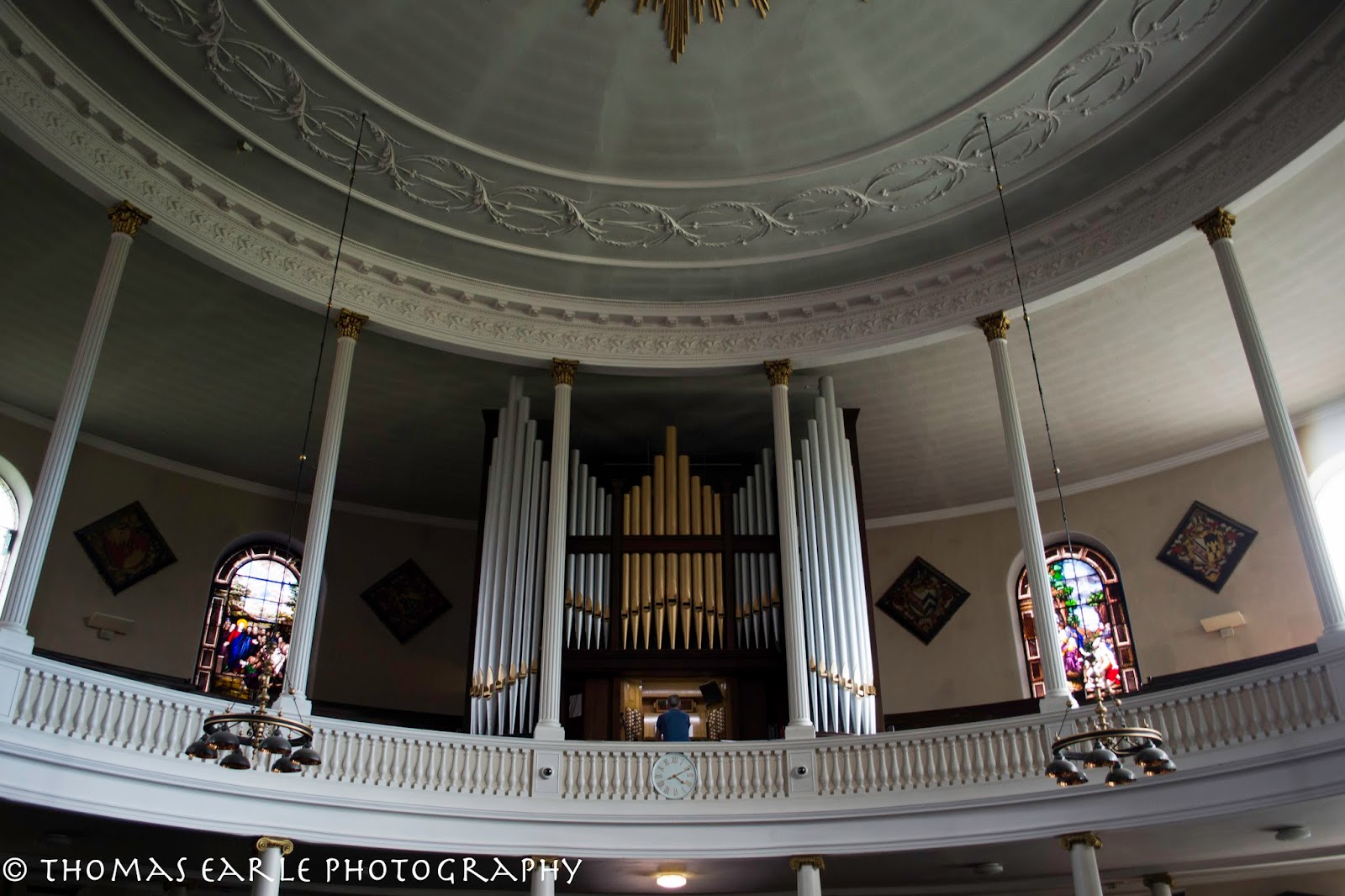
I came upon St Chad's Church, a very distinct church with a high bellower and a round shape for the body of the church.  This version of the church was opened in 1792.  I seem to keep being exceptionally lucky in my timing, as an organist was practicing on the church's organ.  I loved the design of the church with all the pews curving in and the organ and additional seating up on the second level.  In some ways, it is reminiscent of the Red Brick Church in Deerfield, Massachusetts where I went to high school.


Unknowingly, this was my first stop on a tour of the churches of Shrewsbury.  As it was late afternoon on a Sunday, many shops and sites were closed, but I was surprised by how many church doors were still open.  For those who don't know, I have been working on a project for about three years, using long exposure methods to photograph the interior of churches.  It's a bit complicated to explain when not in person and without visual examples, but it's been absolute joy of a project and so when I see towns with many churches I get very excited.  I spend more time in churches than any other atheist I know.

Following another steeple, I came to St. Alkmund's Church, which is towards the center of Shrewsbury.  A caretaker in the church told me a little more about the history of the place and the window above the altar had been replaced fairly recently.  As he told me, it is one of the last examples of a completely painted altar window.  Most are stained glass, but there was a time when painted glass was more fashionable and the man who painted this window, Francis Eginton, was well known for his skill at painting church windows.


From the center of town I went down to the River Severn and walked along the water.  I came to the path by the English Bridge and stumbled upon this gorgeous view: the elegant stone bridge, the well-lit steeple of the United Reformed Church, and a family of swans, including five or so cygnets, swimming down the river.  The banks were particularly verdant, lined with grassy patches, flowers, bushes, and trees, including many, many willow trees dipping their branches into the river.


I crossed the English Bridge and headed towards Shrewsbury Abbey.  I knew it would be closed, but I wanted to see the exterior and find out when I would be able to go into the abbey.  I was struck by the classic red phone booths in front of the cathedral.  Two very distinct British landmarks complementing one another.


I crossed back over the bridge and walked along the river.  There were many people biking and walking as well and the evening was beautiful after the rainfall.  I came back into town and went to the Roman Catholic cathedral in Shrewsbury.  I walked in and was immediately struck by the heavy perfume of incense.  I was unsure if it was remnants from earlier in the day or part of an active service, as there were a small number of people in the church praying.  I decided to wander back out before I disturbed anyone.  I continued to walk through the medieval streets of the town center, before turning back to my hotel for a break before dinner.

Today was a very nice lesson in how, on lucky occasions, things align into a beautiful day.

Saturday, July 4, 2015

Day 8: Riding on the Railroad All the Live-long Day

Happy Fourth of July to all!

Well today I spent seven and a half hours on or waiting for trains.  But it wasn't all a bad experience!  I left my B&B in Caernarfon this morning and went to the Wales Highland Railway train station, right by the harbor.  The railway runs along a historic, narrow gauge railway from Caernarfon to Porthmadog, a harbor town that originally boomed with the slate industry in the region.  The train runs 25 miles, with stops along the way, and is pulled by a steam powered engine.  It felt very much like taking a step into the past.  The train had a first class observation car, with big glass windows and armchairs set before them.  The rest of the cars were made up of small cushioned benches and tables for the third class passengers.  The train even had the classic "toot toot" of what I presume is a steam whistle.  The only downside of jumping back into the past was trying to stay balanced during the unexpected lurches of the train ride. 


The route of the Wales Highland Railway runs through Snowdonia National Park and around the base of Snowdon, the highest mountain in Wales at 3,560 feet.  For the vast majority of my train ride it was a stereotypical British summer morning: cloudy with misting and light rain.  This obscured some of the views from the train, but I think it may have actually been an improvement.  Every mountain peak (especially Snowdon) disappeared into the low-lying clouds and with just a small amount of imagination, it seemed like they could have gone on forever.


Another great part of the view from the train was all the animals grazing in pastures along the train tracks.  I saw thousands of sheep, hundreds of cows, a few horses, three ponies, and just a few goats.  For some reason, I find all of these animals adorable, especially goats and sheep.  I took many, many pictures of the sheep we passed by (partially trying to capture a picture for the fun fact!).  I've decided that there are few things cuter than watching a lamb run through a pasture.  They just look so knobby and uncouth, but so excited.


After the two hour ride, I reached Porthmadog, where I had originally planned on spending the night. Unfortunately I could not find a hotel in advance, so I had planned to keep moving closer to Shrewsbury, my next destination.  I ate a quick lunch in the harbor area and then headed to a different train station, one that has trains that can go farther and faster than the Wales Highland Railway.  The route I took towards Aberystwyth (my port of call for the night) followed the Welsh coastline.  I looked up from a guide book to be struck by views of a beautiful, white, sandy beach and light, clear, blue water.  I questioned again whether or not I should have brought my bathing suit with me.

My train took me from Porthmadog to Machynlleth, where I disembarked and waited for a different train.  My next train took me to Aberystwyth, a beautiful university town on Cardigan Bay.  I found the guest house I'm staying in and took a little break from all my traveling.  Feeling rejuvenated, I made my way down to the promenade by the sea.  There is an expansive beach by the water, running up to meet the road and the pastel, Georgian houses that line the seafront.  In January of 2014, Aberystwyth was severely damaged by a storm and the promenade suffered.  A year and a half later there is still some evidence of reconstruction, but very little and the promenade is lovely.


Walking along the promenade, it is impossible to miss the ruins of Aberystwyth Castle.  The castle is another creation of Edward I, like Caernarfon, but was not used as extensively.  The castle fell into disrepair rather quickly, but was still involved in Welsh rebellions and the English Civil War.  The ruins are now part of a public park, right near the Old College.  I loved that there was a playground, just below the ruins.  It seems like an ingenious way to interest young children in history, by allowing them to play in the shadows of their local history and hopefully encourage their curiosity and desire to explore.


Continuing down the promenade to the South Beach, the harbor comes into view.  There is a long jetty at the end of the harbor and there was a lone angler fishing as I walked towards it.  The views out over the ocean and the landscape outside of town were wonderful.  I reached one end of the promenade and headed back towards the main part of town.  I had a very nice dinner at a small restaurant on the promenade and even indulged in some ice cream as I walked through the town after dinner.

After a long day of travel, it turned into a lovely evening.


Fun Fact #8: So this is sort of a two part fun fact.  Many people may already know this (I actually did), but I was struck by it again.  In the U.S. most sheep tails are docked, leaving them with small, bobbed tails.  But this is not what they naturally look like!  No, sheep have long, wooly tails, larger and longer than many dogs!  I think they make sheep even cuter.  The second part of the fact is that some sheep in Wales are dyed with bright, neon colors.  Apparently in recent years rustling has been on the rise in certain part of the U.K. (I'm not sure about in Wales) and shepherds and farmers have taken to marking their sheep with bright colors so they can identify their animals from great distances.