Showing posts with label Shrewsbury. Show all posts

Tuesday, July 7, 2015

Day 11: Returning to Wales

When I woke up this morning, I only had one thing left on my to do list for Shrewsbury: visit the abbey.  I checked out of my hotel and left my bag before heading down Wyle Cop, across the river, and to the abbey.  The abbey is constructed with the same red stone as Shrewsbury castle and it is a very lovely color.  I had heard that there was something peculiar about the abbey's clock, so I investigated before I went into the building.  For some strange reason, the clock does not use the tradition Roman numeral X for ten.  Instead, it uses an f, so twelve because fII and nine become If.  I don't know why this happened, but it makes for an interesting clock.


The interior was beautiful and surprisingly light, especially the altar, with its golden reredos.  This abbey had a similar history to the old cathedral in Chester.  Both had been much larger before the Dissolution of the Monasteries and both were reduced to smaller parish churches, allowing the rest of the buildings to crumble.  The Shrewsbury Abbey went through many different stages, different layouts as certain parts of the abbey were left to decay and then, later, as restorations were made.  Even today, with many restorations and rebuilding, the church is much smaller than the original abbey would have been


The abbey has Norman beginnings, with the gifting of Shropshire to Roger de Montgomery by William the Conqueror.  In 1083, Roger de Montgomery publicly pledged to build an abbey in Shrewsbury and construction began.  In the 12th century, the abbey grew in importance after the abbot "found" the remains of a Welsh saint, Winifred, and brought them back to Shrewsbury Abbey.  This encouraged pilgrims to come to Shrewsbury and increased the popularity of the abbey.  During the 14th century, the abbey was expanded and renovated.

In 1540, the abbey was shut down and the abbot and monks were given sums of money and sent away.  The abbey shrank to a parish church and suffered neglect for about three centuries.  In the 1800s, more efforts, and maybe more importantly, more funds, were put into restoring the abbey to it's former beauty.


This stained glass window of Saint Winifred is one of the more recent additions to Shrewsbury Abbey, added in 1992.  According to legend, Saint Winifred had a pretty sad early life.  She was the daughter of a Welsh chieftain and at a young age decided she wanted to become a nun.  A suitor of hers did not like this idea and in a fit of rage, chopped of her head.  It rolled away and supposedly a healing spring sprouted from where it stopped.  Her uncle, a saint as well, Beuno, saw the event and asked God to strike the suitor down and the man promptly died.  Beuno then put Winifred's head back on her body and she came back to life.  She then went on to be an abbess and lived a long, happy life.  Her uncle, Beuno, is also credited with resurrection six other people.  All of this reinforces my absolute confusion with Christian mythology, claims that Christianity is a monotheistic religion, and why miracles today are way less interesting than miracles of the past. 


Shrewsbury Abbey was also home to quite a few stone coffins with effigies.  They included the supposed resting place of Roger de Montgomery, the founder of the abbey.  Others were in better shape and painted with a rich palette of colors.  I noticed that in a back corner of the church someone had placed a small flower into the hands of one of the effigies.  It was a sweet, simple gesture and very beautiful.

After visiting the abbey, I attempted to head out of Shrewsbury, but got an extra hour and a half in the  trains station due to train delays.  I almost missed the stop for Llandovery as I was wrapped up in an entertaining podcast and knitting.  But I made it!  My hotel was just across the road from the train station, so I was in my room in no time.  I then found out that the bus I needed to take for tomorrow's excursion (to the Dolaucothi gold mines) does not run on Wednesdays.  It seems I'll have to go by cab which is not ideal.

I wandered into Llandovery, partially to find food and partially to get the rest of my steps in for the day.  It's a small, quiet town, seemingly dominated by the large boarding school that it hosts.  The town center is focused around its town hall and small streets of shops run around it.


I also learned that just outside the town, in a smaller village area, there was another Roman fort.  I had remembered the name from my research before embarking on this trip.  I was tempted to try to walk out to the site, but a storm was beginning to head my way and if I recall correctly, the site isn't really excavated.  I decided to stay within a quick walking distance of my hotel, in case the skies opened up.

Like any good Welsh town, Llandovery has a castle.  The Normans constructed the castle in the 12th century, but it was soon capture by the Welsh.  It switched hands between Welsh and English for the next two centuries.  Like seemingly every castle in Wales, the castle was the sight of the battle between Welsh revolutionary, Owain Glyndŵr, and the English.  This battle in 1403 left the castle crumbling and it was never repaired.


On the same rise as the castle, a shining, silver statue stands, looking out over Llandovery.  The statue commemorates Llwelyn ap Gruffudd, the last Welsh sovereign ruler before Edward I's invasion of Wales.  Llwelyn fought to maintain control in Wales and prevent the English from conquering the territory.  He died in battle against the troops of Edward I.  


After touring the town, grabbing a bite to eat, and poking my head into the British boarding school, I made it back to my hotel, just as the raindrops started to fall.

Fun Fact #11: During the Dissolution of the Monasteries, cataloguing the worth of the monasteries and abbeys was very important so that Thomas Cromwell and Henry VIII knew what value they were adding to the crown's estate.  This was some of the items listed for Shrewsbury Abbey: "some milk, chemise, couch and tomb of the Virgin bones, hair and vestments of apostles and martyrs, saints both male and female, bishops and confessors, a whole rochet of Thomas Becket, part of the rochet in which Thomas Becket was martyred, cloth stained with Thomas Becket's blood and brains, fragments of Thomas Becket's attire including his hair, collar, girdle, cowl, woolen, shirt and glove."  Sacred objects in a church...or the latest episode of Hoarders?


Monday, July 6, 2015

Day 10: Eyeing Roman Ruins

Today began much earlier than it should have, around 12:45 AM to be exact.  I was awoken to someone coming into my room, and although I didn't understand exactly what he said, the blaring alarm and words "fire" and "get out" stuck out pretty distinctly.  I headed outside, grabbing my camera and my hard drive where I save all my photos (what priorities I have!)  We stood around for a few minutes, watching firemen go in and out of the hotel.  There was no smell of smoke or any evidence of fire and eventually we were let back in.  I believe I overheard this morning that it had something to do with a faulty alarm panel.

So I got up this morning, slightly less well rested than I had hoped to be, and headed to the bus station to try to make my way to Wroxeter where a Roman town remains in ruins.  I had just missed a bus and the next one was not for an hour and forty-five minutes, so I decided to go to Shrewsbury Castle.  The castle is a beautiful red color, which stood starkly against the grey, wet sky.  It's quite small, looking more like a country manor house than a proper castle.  This is because the original medieval origins have disappeared to make way for a newer castle.  Up a hill above the castle, is Laura's Tower, a scenic tower looking out over Shrewsbury.


I decided to go into the Shropshire Regimental Museum, housed in the castle as I had so much time to kill.  The collections were impressive and gave great details about British military history.  I was amazed by the collections of honorary medals they had, quite possibly thousands.  I also learned that the first British casualty in World War II was a native, a corporal named Thomas Priday.  It was also entertaining to see some of the military history of the American Revolutionary War from the other side.  I walked into one part of the museum and internally shouted, "The Red Coats are coming!"  I'm a true Bay Stater, through and through.

After taking my time in the museum, I still had plenty of time on my hands and walked farther back into town.  I went to St. Mary's Church, a church located towards the center of Shrewsbury.  Like many churches I've visited in the U.K., they have opened a cafe in one of the side chapels of the church.  I think this is such a clever idea of using space that is generally unused and a way to increase income for churches, many of which need substantial money for repairs.

The church was very beautiful on the inside, but most striking was the stained glass window behind the altar.  It is a 14th century depiction of the Tree of Jesse that has supposedly been in three different churches in Shrewsbury.  Though its been repaired and moved multiple times, many of the original pieces of glass are still in good condition.


I grabbed some lunch on my way back to the bus station and arrived just in time to catch my bus to Wroxeter.  It had been lightly raining all day and continued to as I walked towards the visitor center at the Roman town.  I decided to visit the small museum first to get a sense of the site and the history and to hopefully let the rain stop.

The site was originally home to a Roman fort called Viroconium, built around 58 CE by the Legio XIV Gemina. The legio XX Valeria Victrix soon replaced them, but the fort was not used for long.  Although it was initially an important staging ground for excursions into Wales, the Roman military focus shifted to the north and Chester rose as the main military base.  As the Roman military left Viroconium, they pulled down the walls and destroyed buildings to prevent any native tribes or rebels from taking the defensible position.


As the Roman army moved out, Viroconium transformed into a town.  Veterans stayed behind and locals from the Cornovii tribe moved in.  The town already had traders and markets established and continued to grow as civilian destination.  Over time, it became the fourth largest town in Roman Britain.  The town grew, building more public spaces such as bathes, a market hall, and a forum.  The city, although mixed with different peoples, took on a Roman-style of administration and many of the daily practices stayed within Roman customs.

The city continued to thrive during Roman occupation, even with through changes.  The rise of Christianity altered the nature of the town, as it did in many parts of the empire.  There is evidence for the coexistence of a Christian church and Roman temples during the 3rd century CE, but by the 4th century the worship of pagan gods had been abandoned.  Sacred objects, like the statuette below to Venus, were discarded and found by archaeologists in dump heaps.


When the Romans left Britain in 410 CE, the town was not abandoned.  In the previous years, Viroconium Cornoviorum, as the town (not the fort) was known, had become more self reliant, with fewer imports from other parts of the Empire and more locally made products coming into use.  The town was in a position to survive without connections across the English Channel.  And it did survive for a time, but as conflict rose in sub-Roman Britain, the town began to fade.  In the 6th century, a Mercian king forced all the Christians out of the remaining town.  By the 7th century, the site was abandoned and many of the buildings had been torn down and repurposed.


Today, a very small fraction of Viroconium Cornoviorum has been excavated.  The majority of the excavations are the massive bath complex at the site.  Like in Segontium, most of the ruins just show the foundations of the buildings.  A notable exception is a large piece of the bath wall, nicknamed the Old Work by locals.  The piece comes from the ball of the basilica, that connected into the rest of the bath house.  The basilica would have been 245 feet long by 66 feet wide.  Clearly these bathes and public buildings were meant to accommodate a major settlement, unlike the 600 square foot bathhouse in Prestatyn.

The baths had a large series of hypocausts to heat what would have been a very large tepidarium and calidarium.  The bath also included some unusual features for a place like Shrewsbury.  The most interesting was a natatio, a large, unheated, open-air swimming pool.  It clearly wasn't very popular in the dreary English weather, as it was filled in fairly quickly.


Abutting against the bath complex were multiple public buildings, including a market hall, rooms for officials to meet, and just across a street, the forum.  The market hall would have been two stories and seemed to have at least ten rooms on the first floor for stalls to be set up.  The forum area has not been excavated and the Roman road running between the two areas has been paved over with a modern road.  The forum area is actually underneath a replica of a Roman country house.


The replica home is constructed based off buildings excavated in the Wroxeter area and is meant to represent a Roman home around 320 CE.  I wonder at the decision to build the replica house rather than excavate the forum beneath, but it was an interesting experience to walk through a fully constructed Roman home.  The house contained exemplary rooms, such as a shop at the front of the house that could have been used as a family store, a triclinium (dining room), cubicula (used for various things, but here shown as a bedroom), and small bath complex in the home.  Though the home seems to be set up for teaching children about Roman home life, I still enjoyed wandering through the rooms and getting a fuller sense of what a Roman house was like.

I then scurried off to catch a bus back into Shrewsbury, as they ran every two hours and I had exhausted what I could see at the site.  Wroxeter was a lovely and informative site, but sadly so much has been left undiscovered there.  Hopefully, there will be more chances to dig there!


Fun Fact #10: There is some evidence that Viroconium Cornoviorum was a center for treating eye ailments.  In ancient Roman medicine and religion, it was common to give an offering of the ailed body part to Aesculapius, as an offering to be healed.  Usually there was a promise of future sacrifices as well.  In Wroxeter many fragments with depictions of eyes have been found, like the ones above.  This suggests that there was some specialist or specialists in the town treating (and probably successfully) problems with the eyes!

Sunday, July 5, 2015

Day 9: Embracing the Adventure

I woke up to a glorious morning in Aberystwyth.  The sun was out and I could hear the ocean on the beach from my room.  I decided to pack quickly and grab breakfast on the promenade.  I grabbed a muffin and sat on the wall running along the water.  I was pretty surprised by how drastic the water level was from when I had arrived; most of the beach was now covered and a dock that had stretched out on the water yesterday was mostly covered.

I enjoyed the weather as I headed to the train station, but as I waited for a later train (so I could arrive closer to my check in time, a classic problem of this trip) the weather turned and began to rain.  I sat on a bench in the station, listening to podcasts and knitting.  About twenty minutes before the train was due to arrive, I was joined by two women, Hillary and Kim, who declared they were crocheters and we were going to create a bit of a crafting bench.  They were both lovely and very sweet and had been in Aberystwyth to celebrate one of their soon-to-be daughter-in-law's hen (bachelorette) party.  We couldn't find a table to sit all together on the train, but I sat across the aisle from them.

The woman sitting across the table from me struck up conversation and we ended up taking for the entire train ride, which was around two hours.  Her name was Tracy and she was from New Zealand originally, but truly was a world traveller.  She had recently sold her apartment and car in New Zealand and decided to travel the world until she found the place she wanted to live.  She was fascinating and totally engaging.  We talked about a wide variety of topics, including education, travel, politics, mental health, spirituality, and the list keeps going.

She was continuing on to the Isle of Man, but had to transfer changes at Shrewsbury.  We both had time to kill, her before her next train and I before I could check in to my hotel, so we grabbed lunch together and continued the conversations.  She then had to hurry to her train and we didn't really have any chance to swap contact information.  It's quite possible that I will never here from her again, but it was truly special experience.  And something that would not have happened if I had not been detoured to Aberystwyth or chosen to take that particular train.  It seemed very much the perfect mixture of mistakes and timing.


I arrived into a rainy Shrewsbury and hurried to my hotel.  I learned that my hotel, The Lion, has been an inn since 1618, with some notable visitors like Charles Dickens and Charles Darwin.  It is a very nice hotel located right in the center of Shrewsbury.  I waited a few minutes for the rain to die down, but when I left it was still sprinkling.  I started walking through the town and towards the approaching blue skies.  Shrewsbury has been known for and define by its market and I passed by the Old Market.  From there I went up a slight hill, following the tower of a church.

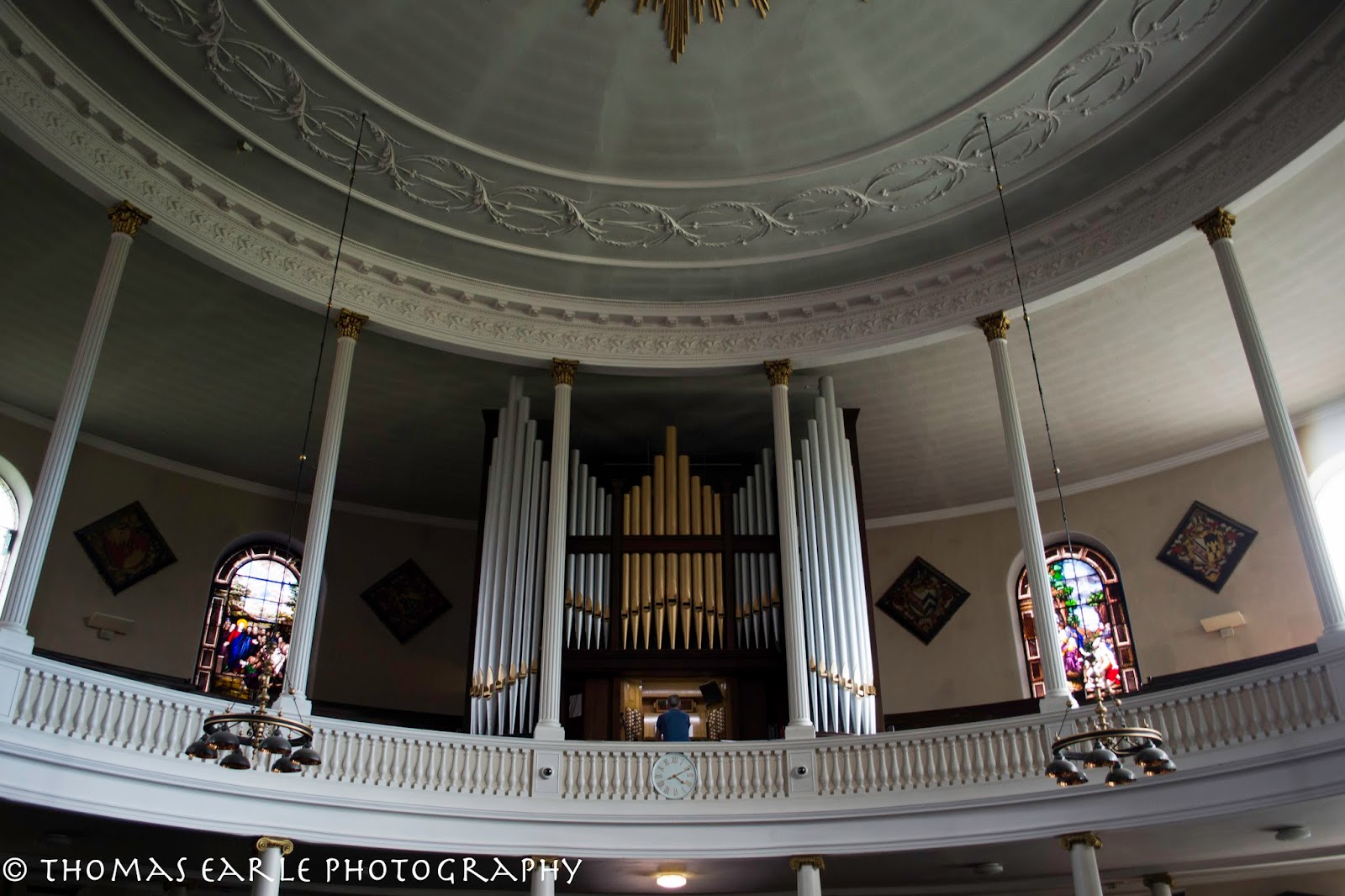
I came upon St Chad's Church, a very distinct church with a high bellower and a round shape for the body of the church.  This version of the church was opened in 1792.  I seem to keep being exceptionally lucky in my timing, as an organist was practicing on the church's organ.  I loved the design of the church with all the pews curving in and the organ and additional seating up on the second level.  In some ways, it is reminiscent of the Red Brick Church in Deerfield, Massachusetts where I went to high school.


Unknowingly, this was my first stop on a tour of the churches of Shrewsbury.  As it was late afternoon on a Sunday, many shops and sites were closed, but I was surprised by how many church doors were still open.  For those who don't know, I have been working on a project for about three years, using long exposure methods to photograph the interior of churches.  It's a bit complicated to explain when not in person and without visual examples, but it's been absolute joy of a project and so when I see towns with many churches I get very excited.  I spend more time in churches than any other atheist I know.

Following another steeple, I came to St. Alkmund's Church, which is towards the center of Shrewsbury.  A caretaker in the church told me a little more about the history of the place and the window above the altar had been replaced fairly recently.  As he told me, it is one of the last examples of a completely painted altar window.  Most are stained glass, but there was a time when painted glass was more fashionable and the man who painted this window, Francis Eginton, was well known for his skill at painting church windows.


From the center of town I went down to the River Severn and walked along the water.  I came to the path by the English Bridge and stumbled upon this gorgeous view: the elegant stone bridge, the well-lit steeple of the United Reformed Church, and a family of swans, including five or so cygnets, swimming down the river.  The banks were particularly verdant, lined with grassy patches, flowers, bushes, and trees, including many, many willow trees dipping their branches into the river.


I crossed the English Bridge and headed towards Shrewsbury Abbey.  I knew it would be closed, but I wanted to see the exterior and find out when I would be able to go into the abbey.  I was struck by the classic red phone booths in front of the cathedral.  Two very distinct British landmarks complementing one another.


I crossed back over the bridge and walked along the river.  There were many people biking and walking as well and the evening was beautiful after the rainfall.  I came back into town and went to the Roman Catholic cathedral in Shrewsbury.  I walked in and was immediately struck by the heavy perfume of incense.  I was unsure if it was remnants from earlier in the day or part of an active service, as there were a small number of people in the church praying.  I decided to wander back out before I disturbed anyone.  I continued to walk through the medieval streets of the town center, before turning back to my hotel for a break before dinner.

Today was a very nice lesson in how, on lucky occasions, things align into a beautiful day.