Showing posts with label Swan. Show all posts

Monday, July 27, 2015

Day 31: Dusting Off Old Books

This morning Ethan headed to Kensington for another meeting and I stuck around to plan my visits to Roman sites in London.  I then went to meet with Ethan and take a stroll through Kensington Gardens and Hyde Park.  As Ethan pointed out, if only we'd had this weather when visiting the palace a few days ago.


The weather was warm, but breezy as we walked around the Round Pond and headed through the gardens.  We followed tree-lined paths to the Long Water, the portion of a serpentine lake in Kensington.


At the end of the Long Water, there is the Italian Garden, consisting of an Italianate building and a terrace with four fountains and flowering ponds.  The garden was a present from Prince Albert to his wife, Queen Victoria.  The walls are decorated with Vs and As.


The garden fell into disrepair and was most recently restored in 1991 and 2011.  Work was done to repair damage to the structure, the stonework, and the ponds themselves.  My favorite addition to the garden was little wooden ramps to ponds to help ducks and ducklings safely get in and out.  The renovation was greatly helped by a grant from Tiffany & Co.


We followed the Serpentine Lake into Hyde Park and watched tourists boating around on the water.  Although I've talked about seeing swans before, Ethan and I were both commenting on the wide variety of birds we've seen in London.  At any one time, in Hyde Park, we could see eight or nine different species of birds.  Many were introduced as gifts or representative specials from around the United Kingdom.


We took the tube from Hyde Park to St. Pancras and King's Cross so we could return to the British Library.  The station was originally slotted for destruction in the 1960s, but was saved and painstakingly restored between 2001 and 2007.  The station now serves domestic trains, but also international ones via the Chunnel.  When we were in the station yesterday we saw trains headed to Paris, Brussels, and Amsterdam.


The train station opened in 1868 and around the same time a massive hotel was built as an attachment to the station.  The Midland Grand Hotel had 300 rooms, each with gold leaf decorations and fireplaces, a grand staircase, hydraulic lifts, and many other top of the line features.  The hotel went out of business in 1935 and was used as railway offices.  After the 1980s, when the building failed safety regulations, it was left empty.


In 2011, the building reopened as the St. Pancras Renaissance Hotel.  The renovations began in 2004, during the revamp of the train station.  The new hotel contains 244 rooms, 2 restaurants, 2 bars, a health and leisure center, a ball room, 20 meeting and function rooms, and on the upper floors of the original building, 68 apartments.


Ethan and I grabbed lunch and then returned to the British Library.  This time we had collected our proper documents and were able to register to use the reading rooms and collections.  We both looked into manuscripts relating to our research.  I was able to find a 17th century manuscript of Tacitus's De Vita et Moribus Iulii Agricolae, which follows the life of the man credited with Romanizing Britain.

The manuscript was quite simple: no cover, simple paper, and written in a brown ink.  The entirety of the book was copied out on 36 pages, although text was only written on the lefthand side of pages and only on on the left page.  (Please excuse the quality of the next three photos.  I was unable to use my camera in the reading room and my phone's camera has damage to the lens, leaving big black dots in all the images.)


I think this may suggest that the righthand sides of the pages were being reserved for the owner's thoughts and commentary, but I may be wrong.  The manuscript came from a larger collection, referred to as the Trumbull Papers, and I did not learn much about the larger collection.  From what I could tell, the collection held a diverse collection of works and topics, so I'm not sure how Tacitus fit in.


Flipping through the pages, it was entertaining to catch the mistakes the scribe had made in copying out the text.  Words were crossed out, added via carets, and squeezed in when forgotten.  I even found one of the most classic scribal errors, which I believe is called a homeoteleuton.  In the photo below, the word habebatur is crossed out and replaced by the correct word narrabatur.  In the line above the word habebat appears and in the copying process, the scribe certainly skipped back a line and brought the earlier habebat below.  Luckily, the mistake was caught and the meaning of the sentence wasn't changed in a very confusing way.


We didn't have as much time with our manuscripts as we would have liked, as the reading room closed at 5pm, but we left the library happy.  We decided to head to the infamous Fleet Street for some meat pies.  Ethan, who loves Sweeney Todd, had found a pie shop located between the supposed location of Todd's barbershop and Mrs. Lovett's pie shop.  Ethan went for a pie and beer tasting dinner, which came with three of the restaurant's most popular pies and paired them with three different beers.  I had a lamb pie with a red wine, rosemary, and mint sauce and a cider.


Overall, it was a successful day, filled with research, wandering, and good food.


Fun Fact #31: Meat pies have origins 11,500 years ago in the Neolithic Age.  They were introduced to the Mediterranean by the Egyptians and were adapted by the Greeks.  They then reached the British Isles through the Romans.  So the Brits have the Romans to thank for one of their favorite national meals.

On the flip side, they also have the Romans to thank for the introduction of stinging nettles, so it's not all great.

Sunday, July 5, 2015

Day 9: Embracing the Adventure

I woke up to a glorious morning in Aberystwyth.  The sun was out and I could hear the ocean on the beach from my room.  I decided to pack quickly and grab breakfast on the promenade.  I grabbed a muffin and sat on the wall running along the water.  I was pretty surprised by how drastic the water level was from when I had arrived; most of the beach was now covered and a dock that had stretched out on the water yesterday was mostly covered.

I enjoyed the weather as I headed to the train station, but as I waited for a later train (so I could arrive closer to my check in time, a classic problem of this trip) the weather turned and began to rain.  I sat on a bench in the station, listening to podcasts and knitting.  About twenty minutes before the train was due to arrive, I was joined by two women, Hillary and Kim, who declared they were crocheters and we were going to create a bit of a crafting bench.  They were both lovely and very sweet and had been in Aberystwyth to celebrate one of their soon-to-be daughter-in-law's hen (bachelorette) party.  We couldn't find a table to sit all together on the train, but I sat across the aisle from them.

The woman sitting across the table from me struck up conversation and we ended up taking for the entire train ride, which was around two hours.  Her name was Tracy and she was from New Zealand originally, but truly was a world traveller.  She had recently sold her apartment and car in New Zealand and decided to travel the world until she found the place she wanted to live.  She was fascinating and totally engaging.  We talked about a wide variety of topics, including education, travel, politics, mental health, spirituality, and the list keeps going.

She was continuing on to the Isle of Man, but had to transfer changes at Shrewsbury.  We both had time to kill, her before her next train and I before I could check in to my hotel, so we grabbed lunch together and continued the conversations.  She then had to hurry to her train and we didn't really have any chance to swap contact information.  It's quite possible that I will never here from her again, but it was truly special experience.  And something that would not have happened if I had not been detoured to Aberystwyth or chosen to take that particular train.  It seemed very much the perfect mixture of mistakes and timing.


I arrived into a rainy Shrewsbury and hurried to my hotel.  I learned that my hotel, The Lion, has been an inn since 1618, with some notable visitors like Charles Dickens and Charles Darwin.  It is a very nice hotel located right in the center of Shrewsbury.  I waited a few minutes for the rain to die down, but when I left it was still sprinkling.  I started walking through the town and towards the approaching blue skies.  Shrewsbury has been known for and define by its market and I passed by the Old Market.  From there I went up a slight hill, following the tower of a church.

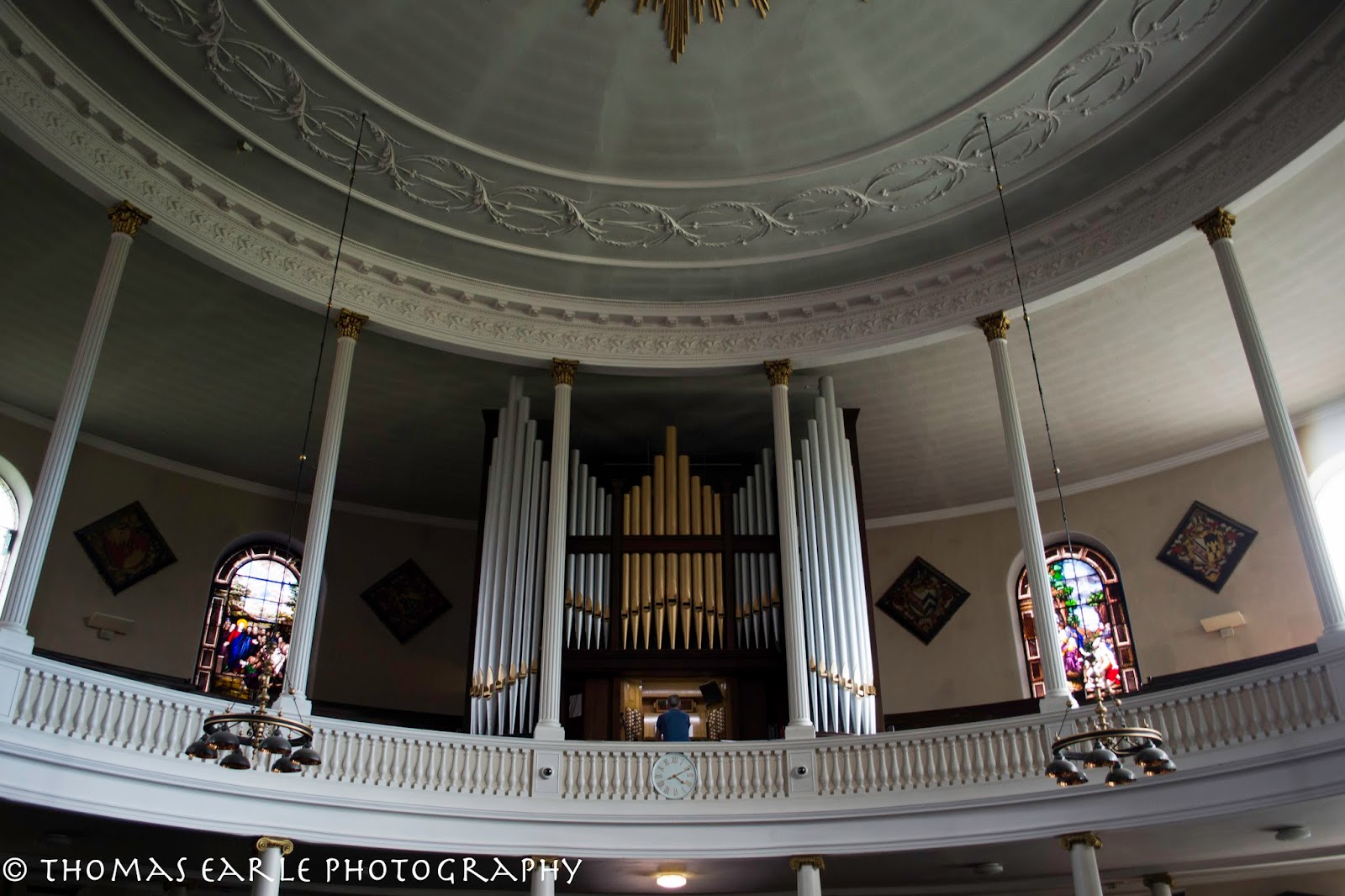
I came upon St Chad's Church, a very distinct church with a high bellower and a round shape for the body of the church.  This version of the church was opened in 1792.  I seem to keep being exceptionally lucky in my timing, as an organist was practicing on the church's organ.  I loved the design of the church with all the pews curving in and the organ and additional seating up on the second level.  In some ways, it is reminiscent of the Red Brick Church in Deerfield, Massachusetts where I went to high school.


Unknowingly, this was my first stop on a tour of the churches of Shrewsbury.  As it was late afternoon on a Sunday, many shops and sites were closed, but I was surprised by how many church doors were still open.  For those who don't know, I have been working on a project for about three years, using long exposure methods to photograph the interior of churches.  It's a bit complicated to explain when not in person and without visual examples, but it's been absolute joy of a project and so when I see towns with many churches I get very excited.  I spend more time in churches than any other atheist I know.

Following another steeple, I came to St. Alkmund's Church, which is towards the center of Shrewsbury.  A caretaker in the church told me a little more about the history of the place and the window above the altar had been replaced fairly recently.  As he told me, it is one of the last examples of a completely painted altar window.  Most are stained glass, but there was a time when painted glass was more fashionable and the man who painted this window, Francis Eginton, was well known for his skill at painting church windows.


From the center of town I went down to the River Severn and walked along the water.  I came to the path by the English Bridge and stumbled upon this gorgeous view: the elegant stone bridge, the well-lit steeple of the United Reformed Church, and a family of swans, including five or so cygnets, swimming down the river.  The banks were particularly verdant, lined with grassy patches, flowers, bushes, and trees, including many, many willow trees dipping their branches into the river.


I crossed the English Bridge and headed towards Shrewsbury Abbey.  I knew it would be closed, but I wanted to see the exterior and find out when I would be able to go into the abbey.  I was struck by the classic red phone booths in front of the cathedral.  Two very distinct British landmarks complementing one another.


I crossed back over the bridge and walked along the river.  There were many people biking and walking as well and the evening was beautiful after the rainfall.  I came back into town and went to the Roman Catholic cathedral in Shrewsbury.  I walked in and was immediately struck by the heavy perfume of incense.  I was unsure if it was remnants from earlier in the day or part of an active service, as there were a small number of people in the church praying.  I decided to wander back out before I disturbed anyone.  I continued to walk through the medieval streets of the town center, before turning back to my hotel for a break before dinner.

Today was a very nice lesson in how, on lucky occasions, things align into a beautiful day.