Showing posts with label Graveyard. Show all posts

Friday, July 17, 2015

Day 21: Reuniting with Ethan

Today was all about travel and reuniting.  I left my hotel in Cardiff after a lovely stay and headed to the train station.  I had misread and thought I was aiming to be on a train at 11:00, but it was actually at 11:30.  This was no problem, as I knew I would beat Ethan to Bath.  But I was excited to hear that he had landed safely and we texted as he made it through immigration, to Paddington Station, and on the train to Bath.

At around 1:30 we were finally back together in Bath, after a long month apart.  We headed to our hotel, which is on a quite residential street a few blocks away from the historic center of Bath.  We took a short break before venturing back out to find some food.


We headed towards the center, where the cathedral is visible from most every street.  The cathedral was closed for the day, as it was being used for some graduation events for the University of Bath.  I think this is for the best, allowing us to visit the cathedral when we are both better rested.

Just next door to the cathedral are the Roman baths, which I cannot wait to see.  I got a few peaks of the building surrounding the Roman site and it is gorgeous.  I'm very excited to see how the baths are preserved in this 19th century center.  I think it will be a fascinating mixture of Roman ruins and Victorian re-imagination of the past. 


As we had missed lunch, we decided to go for a proper afternoon tea.  We shared a pot of Earl Grey tea and many delicious treats.  These included scones with clotted cream and strawberry jam, a lemon meringue tart, a lemon poppyseed cake, a strawberry and cream tart, a brownie, and an assortment of finger sandwiches.


Even though we were both quite hungry, we couldn't finish the tray of delights.  It was a lovely way to spend an hour or so, though.  We were right in the middle of Bath and were able to catch up over good food and good tea.


We wandered around the center a bit more, stumbling upon some odd sights.  A man, some sort of street performer, was putting pigeons on to people.  Both Ethan and I were extremely confused by this.  Why would you want pigeons on you?  Doesn't that just seem like a recipe to be covered in bird poop?  And why would you trust this man to put crazy birds on you?  Just so many questions.


We walked by the Victoria Art Gallery,  an art museum dedicated to Queen Victoria in honor of her diamond jubilee.  The museum is known for its collection of British oil paintings from the 17th century to present.  We may stop in and see them for ourselves in the coming days!


We then headed back to our hotel, exploring Henrietta Park on the way back to our hotel.  I had noticed the ruins of a chapel from our hotel window so we crossed the street and went to St. Mary's Churchyard.  The churchyard dates from the 1800s as a parish church and graveyard.  The graveyard quickly filled to capacity and the parish church was torn down and a new church, St. John's, was built.  A mortuary chapel, used for funerals and baptisms, was built in the churchyard, but also fell out of activity.


The site was left in neglect for many years, and only really begun to be preserved in the early 2000s.  Now it is a quiet place to walk through.  They have put out little signs of graves that are of interest, although Ethan and I didn't understand the significance of any of these.  The on pictured labeled a slab of stone as "A mystery!"  I think they might have been stretching at some points.

We had another little break in the hotel (Ethan took an accidental nap) before heading out to dinner.  After investigating some of Bath's culinary scene, we settled on an Italian restaurant just off the Pulteney Bridge.  I feel like maybe I shouldn't have taken Ethan to an Italian restaurant on his first night in England, but too late now!  Now, we're back in the hotel, getting ready for bed.  Have to say I'm awfully impressed Ethan is still up at 11:20 pm!  Time for sleep now though!

Fun Fact #21: Bath has been known for it's natural hot springs for over 2,000 years.  The hot springs were used both as curative and religious places by native peoples, utilized by the Roman invaders, and by basically all those who have lived in Bath.  The spa had a major heyday in the Georgian era, influencing the design and architecture of the city.  Today, you can still have a relaxing day in the baths, but sadly not the Roman ones.

Wednesday, July 8, 2015

Day 12: Mining for (Roman) Gold

So this morning began with a bit of a struggle.  I had called some taxi services yesterday to get estimates of how much it would cost me to go to the Dolaucothi Mines from Llandovery and had settled on a company.  When I called them this morning to get a lift, thinking who would be using a cab on Wednesday morning, I found that they had no cars available.  I scrambled and called a few other companies and eventually found one that could send a car over.  The trip had already gotten more expensive.

While I was making these calls and waiting for my taxi, there was a constant barrage of weird sounds coming from outside.  The noise was coming from an even odder collection of cars.  The Garbage Run, a car rally starting from the Netherlands, was rolling through tiny, old Llandovery.  The Garbage Run is a rally to show that even old, beaten-up cars can do rallies that are thousands of miles long.  The cars are generally all older model cars that have been seriously personalized.  I saw everything from a car with a tent on top of it to a car shaped like Olaf from Frozen.  I watched a car with a paddleboat glued to it's roof try to fit into a parking spot for about ten minutes.  In all this chaos, my taxi arrived.

My taxi driver was a very sweet man and we had a lovely chat about local culture and Welsh accents as we drove the twenty-five minutes to the mines.  As he dropped me off, he warned me that there would not be taxis until the late afternoon, as they worked school runs.  I'm assuming this meant that schools had hired the taxis to act as buses to bring the students back home to the towns and villages that were farther away from the school.

I arrived at the mines and found out that there would be a Roman tour of the mines about an hour and forty-five minutes after I arrived or a Victorian era tour about an hour earlier.  Clearly, I decided to wait around for the Roman tour.  In the meantime, I wandered around the mining buildings and machines.  The contraption below is called a headframe and was used to lower and raise an elevator into a shaft below.  The shaft below this headframe was 500' deep.  This was not the deepest shaft dug in these mines; I noticed one marked on the map as being 1000' deep.  Now most of the shafts are covered and sealed. 


Most of the machinery around the site is from the 1930s era.  There were three (possibly four) main periods of activity at this mine.  The first was the Romans who began working here in the 1st century CE.  It is possible that the mines had been worked by the natives as early as the Bronze Age, but there is no physical evidence for this.  After the Romans, the mines weren't worked again until the Victorian period.  The were finally worked again between 1933 and 1938 for the final time.


The buildings around the site contain the machinery and tools needed to operate a mine in the 1930s. These included things like giant winches to operate elevators in shafts, generators to create compressed air to power the tools underground, and ventilation controls.  This machine above controlled the flow of compressed air from the generators to three chambers underground.  It was fascinating to look at all the levers and dials on these machines.  It made me realize just how little I know about anything having to do with mining, which ended up being the theme of the day.


They also had a few troughs set up to allow you to try to pan for gold.  When I purchased my ticket, I was given a small plastic bag for any gold I might find while panning.  Gold mining in Wales is not at all like the gold mining in the western United States.  The gold here is not in nugget form, but rather dust.  The dust is trapped in other stones, mainly quartz.  Therefore, the panning process would have been extremely tedious, working to reach the very finest particles.  I gave up rather quickly, perfectly happy to leave without any specks of gold.


Finally it was time for my tour and a group of eight followed our guide, Emyr, around the site.  One of the first things he showed us was a model of a very clever Roman device.  In the 1930s, when working on a shaft 160' below ground, a miner accidentally discovered a massive mining gallery.  It was from the Roman period.  Not only were they shocked to find a Roman mine so deep underground, they were also shocked by it's size (it was nicked named the "Cathedral" because it was so large).  In this gallery, they found evidence of Roman scaffolding and tools, including a curved piece of wood.  Eventually, using examples from other Roman mines in the Mediterranean, they discovered that it was part of the Romans' system of keeping water out of the work site.  They used a series of water wheels that were able to collect water and then poor it into a higher trough, which would then lead to another wheel.  Through a long series of these wheels, the Romans were able to bring water up to the surface level by level.  Emyr demonstrated how this worked with the model they have which is only built to about half scale; the actual water wheels would have been around 12' in diameter.

From the demonstration we walked up the from the bottom of the valley we had been in.  I should say former valley.  The site of the 1930s mining buildings is actually the bottom of the Romans' largest open cast mine.  The bottom is much higher than it would have been in Roman times as it has been partially filled in by natural causes and was used as the waste dump from the Victorian era mines.  The size and scale of this open cast mine is pretty hard to describe and capture with a camera.  It would have been massive.


We continued up the side of the large open cast mine and onto the rise above it.  The landscape here was greatly varied, due to many smaller open cast mines and their dump sites adding dips and hills to the land.  We came across the first Roman drift mine, but could not enter due to unsafe conditions.  We went to the second drift mine (a drift mine is a horizontal mine as opposed to a shaft which goes down) and entered the Roman mine.  The mine was surprisingly beautiful made.  The walls had been worked very precisely, creating a neat corridor with well angled corners leading to the ceiling.  It had clearly been done with painstaking care (which raises many questions as to why).  It was possible to still see some of the pick marks left from Roman tools.


It is estimated that the Romans moved out some half a million tons of stone and collected between three quarters to thirty-five tons tons of gold (we joked about how wide a range that is).  In the mine, we were able to see some galleries in which the Romans followed veins of quartz.  It is believed that the Romans used slave labor for work in these mines, and the presence of a fort nearby means that it might have also used convict labor.  There is a theory that the mine was so large it would have required more than just local slaves and the mine would have drawn slaves from other parts of the Empire.  We saw one drift mine and evidence of many open cast mines, just a small fraction of the site, and I can believe that they would need to bring in extra man power.


There were some interesting features in the main gallery of the mine we visited.  The gallery was a large open space, but would have had many rooms spreading out from it, leading to other galleries.  These have since been filled in, which leaves some aspects of the mine a mystery.  Emyr also pointed out to us some markings that were very exciting...initially.  Carved into the wall were an "IIX" and "IX," presumably some sort of Roman numbering system.  If these were truly Roman, the mistaken IIX for eight (instead of VIII) could have been easily explained away as a mistake by a local slave or possibly even by a miner working upside down (I'm not so sure about this theory).  The distance between the two markers is also roughly a cubit.  However, the two numbers appear on different levels of shale, which seems odd for something being used for an exact measurement.  Therefore it seems somewhat likely that these were added in the 19th or 20th century by Victorian or Cardiff University pranksters.

After leaving the drift mine, we passed by remains of more small open cast mine and evidence of a complex water system that the Romans used for ground sluicing.  This technique allowed them to wash away upper layers of shale to find the quartz veins below.  To do this, the Romans had to build an aqueduct six miles upstream and channel the water into holding tanks.  In a single day, the sluicing system could have used two million tons of water.  It is also likely that this system was adapted to be part of the processing of the quartz.  After this explanation, we headed back down the hill and to the base of the Romans' large open cast mine.

Here, I ran into another problem.  My tour had come to an end and there were not going to be any available taxes from almost two hours.  I had also exhausted most everything I wanted to know about the site.  So I put on my most innocent face and asked a woman from my tour if she happened to be heading in the area of Llandovery.  After consulting a map, it happened that she was heading that way and offered me a ride.  She was absolutely lovely and we swapped travel stories, mostly about getting lost in inconvenient places.  By 3:30 I was already back at my hotel.


After taking a break for a snack and to listen to some podcasts, I decided I would try to go find the Roman fort site outside Llandovery after all.  It was only supposed to be about a mile outside town and I didn't have much else to do.  I made my way down the road, and after a few minutes of confusion, found the church that was meant to be near the site.  There was nothing remotely fort-like about the setting.  There was the church with a graveyard, a residential neighborhood, and a big pasture.  There was a walking sign pointing to the pasture, so I thought maybe I'd find something at the bottom of it.  As I was going I read a bit more about the Roman fort, called Alabum, and found out that I was standing at the site and there was really nothing left of it, just bits of evidence found by various vicars of the church.  I was a bit disappointed, but easily distracted as I made more horse friends.


Fun Fact #12:  I learned a great deal of facts about gold today and I think rather than doing one fun fact I will share quite a few in a list!
1. Welsh gold is the most valuable gold in the world.  This has to do with both its rarity and the fact that the last gold mine in Wales shut down in 1999.
2. Gold is one of the ten rarest elements on Earth.
3. A lump of gold the size of a matchbox could be hammered out into the size of a tennis court.
5. An ounce of gold could be made into a wire fifty miles long.
6. Romans used gold in their dentistry, including making gold wires to hold teeth in places.  (I'm imagining golden braces.)

Sunday, July 5, 2015

Day 9: Embracing the Adventure

I woke up to a glorious morning in Aberystwyth.  The sun was out and I could hear the ocean on the beach from my room.  I decided to pack quickly and grab breakfast on the promenade.  I grabbed a muffin and sat on the wall running along the water.  I was pretty surprised by how drastic the water level was from when I had arrived; most of the beach was now covered and a dock that had stretched out on the water yesterday was mostly covered.

I enjoyed the weather as I headed to the train station, but as I waited for a later train (so I could arrive closer to my check in time, a classic problem of this trip) the weather turned and began to rain.  I sat on a bench in the station, listening to podcasts and knitting.  About twenty minutes before the train was due to arrive, I was joined by two women, Hillary and Kim, who declared they were crocheters and we were going to create a bit of a crafting bench.  They were both lovely and very sweet and had been in Aberystwyth to celebrate one of their soon-to-be daughter-in-law's hen (bachelorette) party.  We couldn't find a table to sit all together on the train, but I sat across the aisle from them.

The woman sitting across the table from me struck up conversation and we ended up taking for the entire train ride, which was around two hours.  Her name was Tracy and she was from New Zealand originally, but truly was a world traveller.  She had recently sold her apartment and car in New Zealand and decided to travel the world until she found the place she wanted to live.  She was fascinating and totally engaging.  We talked about a wide variety of topics, including education, travel, politics, mental health, spirituality, and the list keeps going.

She was continuing on to the Isle of Man, but had to transfer changes at Shrewsbury.  We both had time to kill, her before her next train and I before I could check in to my hotel, so we grabbed lunch together and continued the conversations.  She then had to hurry to her train and we didn't really have any chance to swap contact information.  It's quite possible that I will never here from her again, but it was truly special experience.  And something that would not have happened if I had not been detoured to Aberystwyth or chosen to take that particular train.  It seemed very much the perfect mixture of mistakes and timing.


I arrived into a rainy Shrewsbury and hurried to my hotel.  I learned that my hotel, The Lion, has been an inn since 1618, with some notable visitors like Charles Dickens and Charles Darwin.  It is a very nice hotel located right in the center of Shrewsbury.  I waited a few minutes for the rain to die down, but when I left it was still sprinkling.  I started walking through the town and towards the approaching blue skies.  Shrewsbury has been known for and define by its market and I passed by the Old Market.  From there I went up a slight hill, following the tower of a church.

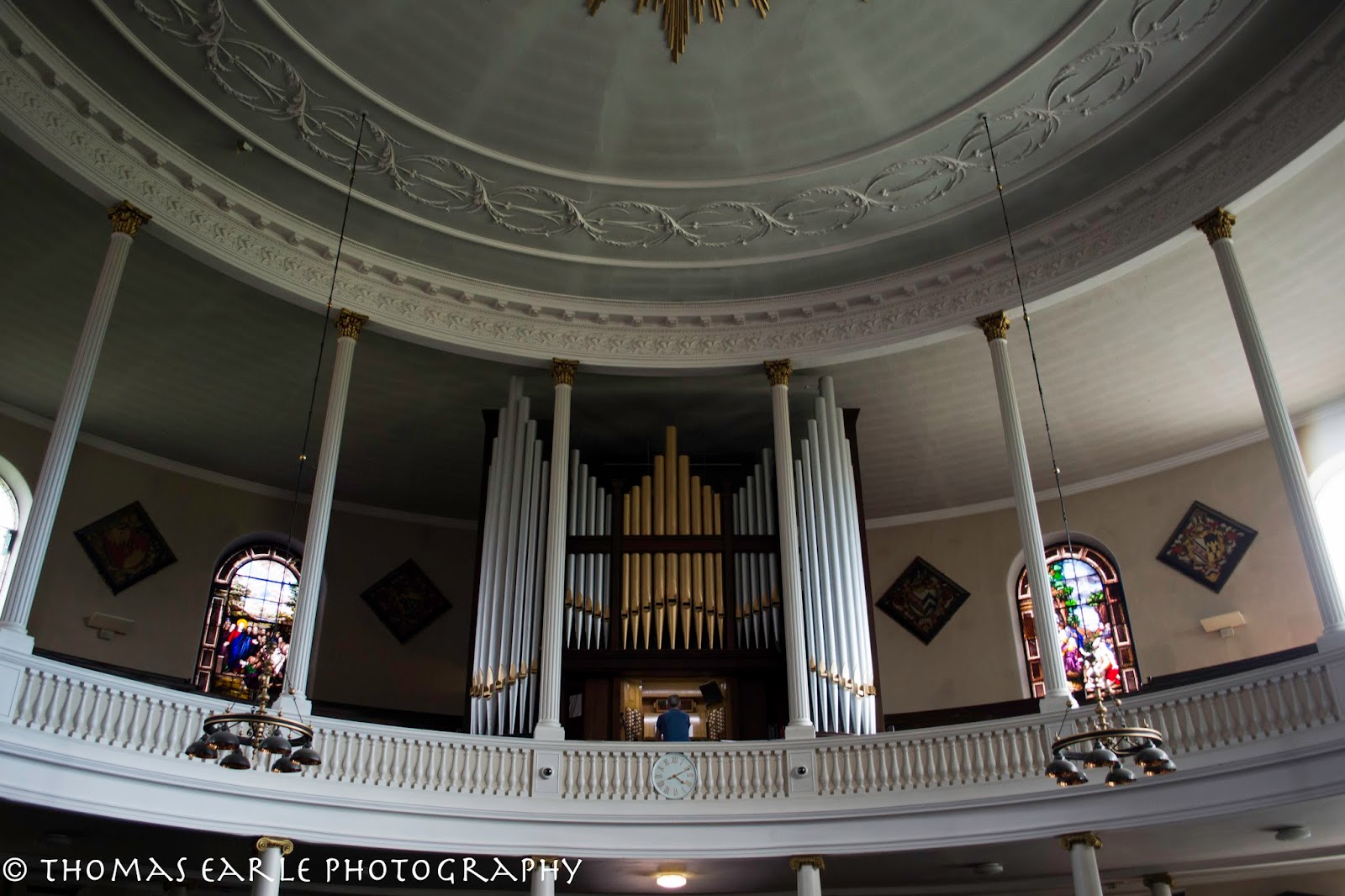
I came upon St Chad's Church, a very distinct church with a high bellower and a round shape for the body of the church.  This version of the church was opened in 1792.  I seem to keep being exceptionally lucky in my timing, as an organist was practicing on the church's organ.  I loved the design of the church with all the pews curving in and the organ and additional seating up on the second level.  In some ways, it is reminiscent of the Red Brick Church in Deerfield, Massachusetts where I went to high school.


Unknowingly, this was my first stop on a tour of the churches of Shrewsbury.  As it was late afternoon on a Sunday, many shops and sites were closed, but I was surprised by how many church doors were still open.  For those who don't know, I have been working on a project for about three years, using long exposure methods to photograph the interior of churches.  It's a bit complicated to explain when not in person and without visual examples, but it's been absolute joy of a project and so when I see towns with many churches I get very excited.  I spend more time in churches than any other atheist I know.

Following another steeple, I came to St. Alkmund's Church, which is towards the center of Shrewsbury.  A caretaker in the church told me a little more about the history of the place and the window above the altar had been replaced fairly recently.  As he told me, it is one of the last examples of a completely painted altar window.  Most are stained glass, but there was a time when painted glass was more fashionable and the man who painted this window, Francis Eginton, was well known for his skill at painting church windows.


From the center of town I went down to the River Severn and walked along the water.  I came to the path by the English Bridge and stumbled upon this gorgeous view: the elegant stone bridge, the well-lit steeple of the United Reformed Church, and a family of swans, including five or so cygnets, swimming down the river.  The banks were particularly verdant, lined with grassy patches, flowers, bushes, and trees, including many, many willow trees dipping their branches into the river.


I crossed the English Bridge and headed towards Shrewsbury Abbey.  I knew it would be closed, but I wanted to see the exterior and find out when I would be able to go into the abbey.  I was struck by the classic red phone booths in front of the cathedral.  Two very distinct British landmarks complementing one another.


I crossed back over the bridge and walked along the river.  There were many people biking and walking as well and the evening was beautiful after the rainfall.  I came back into town and went to the Roman Catholic cathedral in Shrewsbury.  I walked in and was immediately struck by the heavy perfume of incense.  I was unsure if it was remnants from earlier in the day or part of an active service, as there were a small number of people in the church praying.  I decided to wander back out before I disturbed anyone.  I continued to walk through the medieval streets of the town center, before turning back to my hotel for a break before dinner.

Today was a very nice lesson in how, on lucky occasions, things align into a beautiful day.

Friday, July 3, 2015

Day 7: Finding A Flat Fort

Today the weather in Caernarfon was much improved.  I woke up to sunny skies and a warm day.  After a nice breakfast in my B&B and a relaxed morning, I headed out of the main part of Caernarfon, towards the Roman fort Segontium.  The fort sits just outside the medieval part of Caernarfon on a slight rise near the Seiont River.  From the position, the fort would have had views of most of the countryside and out towards the Menai Strait and Anglesey.  Sadly for me, the visitor center at Segontium was closed, so I dove straight into the site.

The ruins are solely the foundations of the buildings in the fort and a few bits of the walls.  This made it quite difficult to get a sense of the fort initially: just an expanse of low-lying stones.  Also, with just a small pamphlet with a barebones information, it took me a few minutes of walking around to identify where I was with in the fort.  But once I got the lay of the land, things fell into place.  The majority of the structures were barracks for the Roman auxiliary troops stationed in Segontium.  Based on the number and size of barracks, it seemed that the fort, if fully manned, would host around 1,000 soldiers.  Other structures in the fort included storage buildings, troop headquarters, the commander's home, and a small bath complex.


The headquarters, part of which is shown above, contained the regimental shrine, offices, and a judgement hall.  Not all of the foundations of the headquarters were visible.  They disappear into a hedge and then into someone's (a very lucky someone) backyard.  Sadly, this is true for a lot of the site; there are structures over parts of the fort and a major road leading into Caernarfon cuts right through the fort, even overlapping with the via principalis for a ways.  It seemed that the room depicted above was a large, two-story hall, based on the slots in the floor to fit wooden columns.  It also could have been some sort of porticoed entrance or meeting room to the headquarters.  In a small room, towards one end of the headquarters, a strongroom had been added in the 3rd century CE. 

I was struck by how large the commander's house was, especially in comparison to the headquarters.  As I realized that I couldn't see the entire layout of the headquarters, I was less confused, but the commander's home still seemed far too large to be just a residence.  There were many rooms of varying size and a large courtyard of the building.  It seemed to be a building of quite importance.  Segontium was the most important fort in northern Wales, acting to control the region in conjunction with other forts, like Chester.  The size of the commander's house makes it seem like the fort would have also served a more administrative and political function in the area, possibly as way for the  Romans to establish greater control over locals or establish more of a Roman population in the area.


According to my little pamphlet, there was a civilian home within the fort at one point.  This seems odd to me, but I'm not certain of its abnormality.  It did seem to fall into the idea that Segontium served a more political function, especially if the building was home to an official in the province or someone of such importance.  The home was later converted into a bath complex, but not completed. This part of the fort was across the road leading into Caernarfon, surrounded by a wall and with a locked gate.  Despite seeing multiple locals hop the wall or gate, I decided to not test my luck.  I think there are things the Welsh locals can get away with more easily than an American tourist.  I settled for walking around the remains of the walls of the fort.  The site of the fort had been built up by the Romans and presumably a defensive ditch had also been dug around the fort.  Along the wall remains, I came across the base of one of the towers in the wall.  Along with this tower base, I was able to see the foundations of two of the four major gates of the fort.  It was very cool to see how the  gates perfectly aligned with the major Roman roads of the fort.

After wandering around the walls, I had seen what I could of the fort.  Still in the mood to walk around, I headed to a church a few dozen feet away from Segontium.  The church was closed, but the grounds were open so I walked around.  The church was surrounded by a graveyard, but quite a unique one.  I'm not sure why, if it was through lack of care or intentionally, but the entire graveyard was filled with wild grasses and flowers.  It was quite amazing to see; the stones stood, but the land had been reclaimed by nature.  It felt very appropriate for some reason.  I loved the contrast of the fixed, unmoving tombstones in the fields of waving grasses and blossoming flowers.


I came back to Caernarfon for a nice, quick lunch and decided to explore the exterior of the castle more.  Apparently, when it was originally constructed, the castle was banded with different colors (somewhat visible in the stones; look for a reddish tone) in a way similar to Roman forts.  I crossed the swing bridge over the harbor (after I saw it open and close for a tour boat) and walked along the coast.  I spent a relaxing while on a little, rocky beach skipping stones into the Menai Strait.


I walked lazily back, going along the promenade running alongside the Strait and the medieval walls. With not much left to explore, I headed back to my hotel.  I had a relatively uninteresting afternoon.  Caernarfon was my last reserved hotel, so the afternoon was spent trying to plan for the next coming days and running into many, many roadblocks.  It seems like I now have plan for the coming days, but I will update as I go!

I had a relaxed dinner and managed to finish "The City and the Pillar," which continued to be an amazing read and I'm excited to have finished such a good book, but sad it's over!  Hopefully I will continue to have good luck with books this summer!


Fun Fact #7: Gwynedd, the county in which Caernarfon is located, has the highest proportion of Welsh speakers in Wales.  The Caernarfon area also has a noticeable and distinct dialect, that is supposedly hard for even the Welsh speakers to understand.  I, who speaks and understands zero Welsh, was surprised to find that I could tell the Caernarfon dialect from other Welsh I've heard on this trip.