Showing posts with label River. Show all posts

Sunday, July 12, 2015

Day 16: Moving into Cardiff

With not much else to do in Newport, I had a relaxed morning in my hotel and then headed to the train station.  I knew I would be arriving in Cardiff earlier than I had told my next hotel, so I decided to wait for a later train.  The trains came so often, that waiting for three trains to go to Cardiff before boarding, I had only been in the station for about 20 minutes.  So I took the train and decided to have a long lunch in the station to arrive at my hotel at a more appropriate time.  I also decided to wait for the rain to lighten up a bit before walking the mile to my hotel.

It's hard to describe how excited I was to get to my hotel.  The walk to it, although a bit long with a  heavy suitcase, was through the center of Cardiff and I was really intrigued by the city.  But the thing that was the most exciting was the fact that I will be in my hotel for five consecutive nights.  No long haul to a hotel for a single night, a quick pack in the morning, and back on the train.  It feels like I am moving into this hotel.  This may become my new home.

After an hour or two of decompressing, I decided to wander towards Cardiff center.  I entered Sophia's Garden, a large, green park along the River Taff.  I walked right on the river bank, enjoying the quite of the setting.  I noticed what I believe is a grey heron fishing in the shallows.  As I worked to switch my camera lens to a longer zoom, the heron took off and I was able to capture some pictures of it flying and landing farther down the river.


I moved farther along the banks, trying to get closer so I could get more pictures of the bird.  As I walked, the poor heron began to be harassed by a flock of seagulls.  Before I was close enough to get photos, the gulls had chased the heron far down the river.


I crossed over a footbridge from Sophia's Garden to Bute Park, another part of Cardiff's "green lung."


I wandered aimlessly through the park, so I stumbled upon things, rather than knowing what I should be finding.  I saw the preserved layout of an old friary and a circle of standing stones, which I'm doubting are original.  Even in the rainy weather, the blooming flowers and the greenery reminded me of warmer seasons.


I angled my way towards Cardiff Castle and walked around the walls.  I'm already a big fan of the castle, and I've seen very little of it so far.  It has a dramatic, tall wall that is surrounded by a very proper moat.  I think the moat may be reformed and different from medieval times (certainly Roman times; the River Taff now runs a different course than it did in ancient times).  But still, it looks fantastic today!


  I got quite hungry pretty early in the evening so I started heading back towards my hotel and some restaurants in the area.  On my route back is the Animal Wall.  The wall was thought up in 1866, but not constructed until 1890.  The wall originally had nine animals climbing over the wall and six were added later.  They were renovated in 2010 and look fantastic.  It seems like the local zoo has had a massive escape and you'll see an elephant on Castle street at any second.


One last site I saw on my way back to my hotel was the Millennium Stadium.  It was built for the 1999 Rugby World Cup and has been used to host rugby and football matches, as well as concerts and large events.  I don't think the picture really does it justice, but it is a very interesting building! 


After my wandering, I stuffed myself with a gigantic calzone and had a quiet evening back at my hotel.  Excited to do more exploring tomorrow!

Fun Fact #16: Cardiff was named the capital of Wales in 1955.  Caernarfon was also considered for the capital city, but instead Cardiff was named and later became the seat for the National Assembly of Wales, now housed in a building called the Senedd.

Saturday, July 11, 2015

Day 15: Making it to the Museum

Leaving Port Talbot, I headed to the "Pittsburgh of Wales," Newport.  People are really enjoying telling me what American equivalent I'm headed to next.  Again, I disagree, although I have never been to Pittsburgh either.  Newport reminds me of want-to-be Boston in a lot of ways.  It has a nice stretch along the River Usk that they are trying to develop into a center of arts and culture, but the process seems to be going slow.  There is a lot of construction and renovation happening around the city.  So the city really seems like a work in progress.

Traveling so much has made me lose sense of time.  I rarely know what day of the week it is, which almost became a major problem.  I was planning on heading to the Newport Museum, the point of my visit, tomorrow.  As I was walking to my hotel, I had a vague memory that today was Saturday and that most museums are closed on Sundays (you know, like most things).  So I thought to check the times on the museum, and turns out it is closed on Sundays.  It would have been horrible to miss another museum.

So I headed out towards the museum (and managed to get lost in the midst of the construction).  Once I found the museum, I was surprised to find a trove of Roman artifacts.  The museum contains many pieces from the excavations in Caerleon and Caerwent, two sites outside Cardiff that I will be seeing in the next few days.  The prehistoric and Roman room was well divided into different cases, such as ones dedicated to the region in the Iron Age and the Bronze Age.  Once it became more focused on the Roman occupation, the cases focused on Roman religion, domestic life, jewelry, the army, etc.  Here are just a few selections of the many interesting things from the museum.


This dish is from what is known as Caerleon ware.  The ware was produced in the Caerleon area and shows influence from other Roman pottery, such as the famous Samian ware.  Some of the pieces were even meant to imitate the Samian ware from Gaul, suggesting that the citizens of Caerleon wanted a cheaper, easier to get alternative to importing more pottery. 


There was also another style of local pottery, presumably more of a common, everyday pottery.  It was grey, rather than the preferred red tones found in Samian or Caerleon ware.


Another wonderful piece of the collection was a Roman glass urn with human remains still inside.  In the 1st and 2nd centuries, cremation was the main mode of Roman burial.  This changed later (and varied around the Empire), leading to many beautiful sarcophagi, but it is very cool to see the remains of a Roman, around 2,000 years later.  Or maybe I just find that cool...


The museum also had a beautiful collection of jewelry and clothing items, like this penannular brooch.  These brooches are a great example of Roman and Celtic fashions coming together.  They became particular popular in Roman Britain during the 3rd and 4th centuries, often adding images of animals to the brooches (not quite visible in this photo).


There were also some lovely fragments of frescoes discovered in Caerleon.  Most, like this depiction of a male figure, were done sometime in the 4th century, but there is evidence that there were earlier frescoes in some places that had been plastered over.


There is a great deal of evidence in this museum of the mixing of native British and Roman cultures.  Here is a depiction of a Celtic mother goddess found in a Roman home in Caerwent.  She seems to have been worshipped as a fertility goddess.  Other similar Celtic depictions included a male statue and an antefix tile with the depiction of a Celtic feline goddess (although this is not entirely certain).


A final, special gem was this Roman tile with a paw print in it.  It is very fun to imagine the ancient craftsmen making this tile and then watching a favorite dog run across it, ruining the tile.  It's wonderful when little bits like this survive in history!

After seeing the museum, I went a walk along the River Usk.  Below you can see the Riverfront Center, which houses a gallery and a performance space, and a pedestrian footbridge.  There is a nice walk running along the river itself.


My hotel, along with a many residential neighborhoods of Newport, lay across the River Usk.


A detail of the pedestrian footbridge.


Fun Fact #15: So this fact may not be quite a fact.  Like most museum displays, sources aren't cited, but the Newport Museum had a display titled "What money was worth at Caerwent in AD 122?"  I'm not quite sure where this information was derived, but here's what things cost in Caerwent 1,893 years ago!

Annual pay of a Roman legionary: 300 denarii
Half liter of wine: 1 as
Cloak: 5 denarii and 2 asses
Slave boy: 600 denarii
Loaf of bread: 2 asses
(Roman currency is confusing and variable, so for simplicity sake, at this time an as would have been worth 1/16th of a denarius)

Sunday, July 5, 2015

Day 9: Embracing the Adventure

I woke up to a glorious morning in Aberystwyth.  The sun was out and I could hear the ocean on the beach from my room.  I decided to pack quickly and grab breakfast on the promenade.  I grabbed a muffin and sat on the wall running along the water.  I was pretty surprised by how drastic the water level was from when I had arrived; most of the beach was now covered and a dock that had stretched out on the water yesterday was mostly covered.

I enjoyed the weather as I headed to the train station, but as I waited for a later train (so I could arrive closer to my check in time, a classic problem of this trip) the weather turned and began to rain.  I sat on a bench in the station, listening to podcasts and knitting.  About twenty minutes before the train was due to arrive, I was joined by two women, Hillary and Kim, who declared they were crocheters and we were going to create a bit of a crafting bench.  They were both lovely and very sweet and had been in Aberystwyth to celebrate one of their soon-to-be daughter-in-law's hen (bachelorette) party.  We couldn't find a table to sit all together on the train, but I sat across the aisle from them.

The woman sitting across the table from me struck up conversation and we ended up taking for the entire train ride, which was around two hours.  Her name was Tracy and she was from New Zealand originally, but truly was a world traveller.  She had recently sold her apartment and car in New Zealand and decided to travel the world until she found the place she wanted to live.  She was fascinating and totally engaging.  We talked about a wide variety of topics, including education, travel, politics, mental health, spirituality, and the list keeps going.

She was continuing on to the Isle of Man, but had to transfer changes at Shrewsbury.  We both had time to kill, her before her next train and I before I could check in to my hotel, so we grabbed lunch together and continued the conversations.  She then had to hurry to her train and we didn't really have any chance to swap contact information.  It's quite possible that I will never here from her again, but it was truly special experience.  And something that would not have happened if I had not been detoured to Aberystwyth or chosen to take that particular train.  It seemed very much the perfect mixture of mistakes and timing.


I arrived into a rainy Shrewsbury and hurried to my hotel.  I learned that my hotel, The Lion, has been an inn since 1618, with some notable visitors like Charles Dickens and Charles Darwin.  It is a very nice hotel located right in the center of Shrewsbury.  I waited a few minutes for the rain to die down, but when I left it was still sprinkling.  I started walking through the town and towards the approaching blue skies.  Shrewsbury has been known for and define by its market and I passed by the Old Market.  From there I went up a slight hill, following the tower of a church.

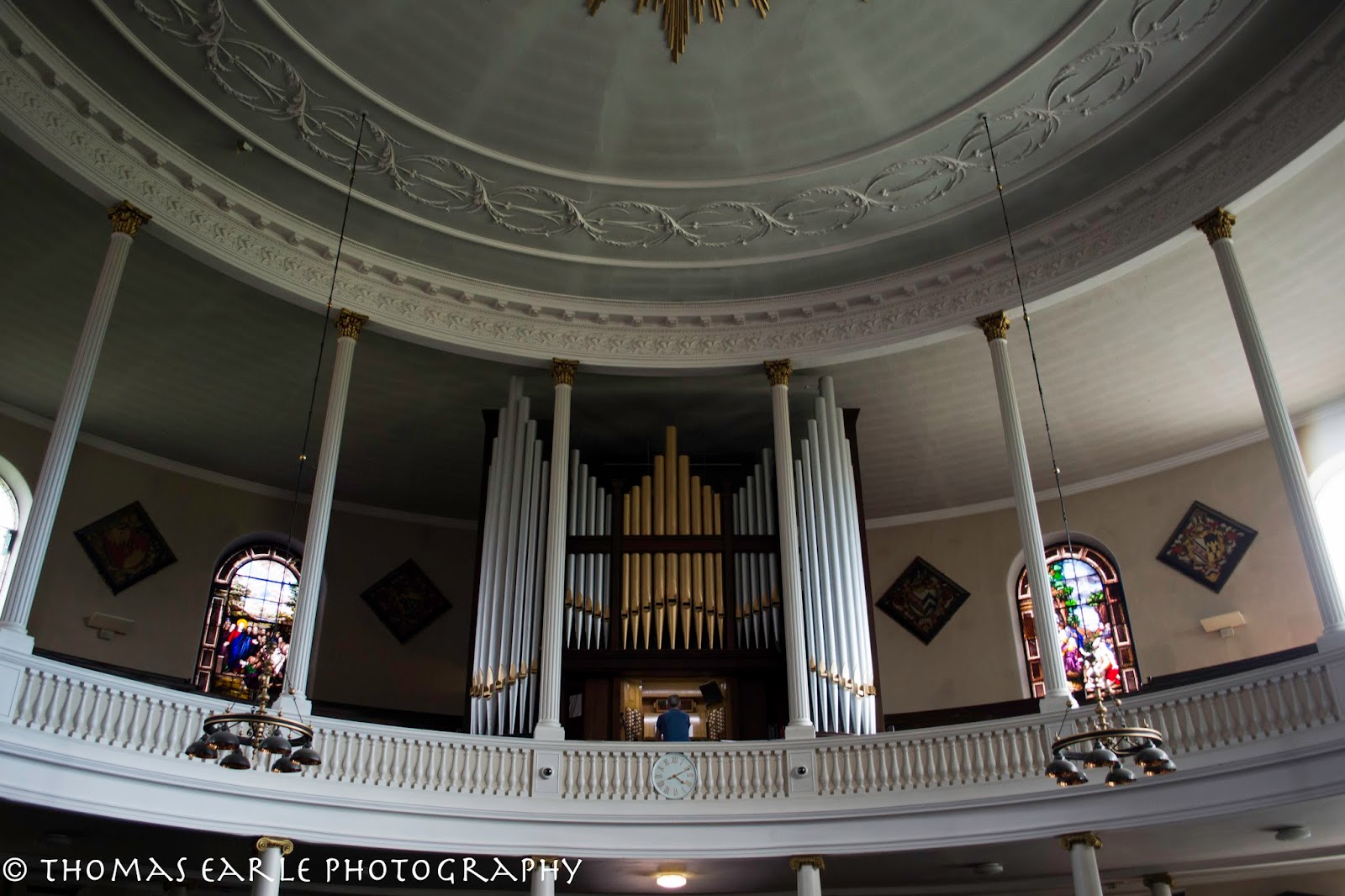
I came upon St Chad's Church, a very distinct church with a high bellower and a round shape for the body of the church.  This version of the church was opened in 1792.  I seem to keep being exceptionally lucky in my timing, as an organist was practicing on the church's organ.  I loved the design of the church with all the pews curving in and the organ and additional seating up on the second level.  In some ways, it is reminiscent of the Red Brick Church in Deerfield, Massachusetts where I went to high school.


Unknowingly, this was my first stop on a tour of the churches of Shrewsbury.  As it was late afternoon on a Sunday, many shops and sites were closed, but I was surprised by how many church doors were still open.  For those who don't know, I have been working on a project for about three years, using long exposure methods to photograph the interior of churches.  It's a bit complicated to explain when not in person and without visual examples, but it's been absolute joy of a project and so when I see towns with many churches I get very excited.  I spend more time in churches than any other atheist I know.

Following another steeple, I came to St. Alkmund's Church, which is towards the center of Shrewsbury.  A caretaker in the church told me a little more about the history of the place and the window above the altar had been replaced fairly recently.  As he told me, it is one of the last examples of a completely painted altar window.  Most are stained glass, but there was a time when painted glass was more fashionable and the man who painted this window, Francis Eginton, was well known for his skill at painting church windows.


From the center of town I went down to the River Severn and walked along the water.  I came to the path by the English Bridge and stumbled upon this gorgeous view: the elegant stone bridge, the well-lit steeple of the United Reformed Church, and a family of swans, including five or so cygnets, swimming down the river.  The banks were particularly verdant, lined with grassy patches, flowers, bushes, and trees, including many, many willow trees dipping their branches into the river.


I crossed the English Bridge and headed towards Shrewsbury Abbey.  I knew it would be closed, but I wanted to see the exterior and find out when I would be able to go into the abbey.  I was struck by the classic red phone booths in front of the cathedral.  Two very distinct British landmarks complementing one another.


I crossed back over the bridge and walked along the river.  There were many people biking and walking as well and the evening was beautiful after the rainfall.  I came back into town and went to the Roman Catholic cathedral in Shrewsbury.  I walked in and was immediately struck by the heavy perfume of incense.  I was unsure if it was remnants from earlier in the day or part of an active service, as there were a small number of people in the church praying.  I decided to wander back out before I disturbed anyone.  I continued to walk through the medieval streets of the town center, before turning back to my hotel for a break before dinner.

Today was a very nice lesson in how, on lucky occasions, things align into a beautiful day.

Friday, July 3, 2015

Day 7: Finding A Flat Fort

Today the weather in Caernarfon was much improved.  I woke up to sunny skies and a warm day.  After a nice breakfast in my B&B and a relaxed morning, I headed out of the main part of Caernarfon, towards the Roman fort Segontium.  The fort sits just outside the medieval part of Caernarfon on a slight rise near the Seiont River.  From the position, the fort would have had views of most of the countryside and out towards the Menai Strait and Anglesey.  Sadly for me, the visitor center at Segontium was closed, so I dove straight into the site.

The ruins are solely the foundations of the buildings in the fort and a few bits of the walls.  This made it quite difficult to get a sense of the fort initially: just an expanse of low-lying stones.  Also, with just a small pamphlet with a barebones information, it took me a few minutes of walking around to identify where I was with in the fort.  But once I got the lay of the land, things fell into place.  The majority of the structures were barracks for the Roman auxiliary troops stationed in Segontium.  Based on the number and size of barracks, it seemed that the fort, if fully manned, would host around 1,000 soldiers.  Other structures in the fort included storage buildings, troop headquarters, the commander's home, and a small bath complex.


The headquarters, part of which is shown above, contained the regimental shrine, offices, and a judgement hall.  Not all of the foundations of the headquarters were visible.  They disappear into a hedge and then into someone's (a very lucky someone) backyard.  Sadly, this is true for a lot of the site; there are structures over parts of the fort and a major road leading into Caernarfon cuts right through the fort, even overlapping with the via principalis for a ways.  It seemed that the room depicted above was a large, two-story hall, based on the slots in the floor to fit wooden columns.  It also could have been some sort of porticoed entrance or meeting room to the headquarters.  In a small room, towards one end of the headquarters, a strongroom had been added in the 3rd century CE. 

I was struck by how large the commander's house was, especially in comparison to the headquarters.  As I realized that I couldn't see the entire layout of the headquarters, I was less confused, but the commander's home still seemed far too large to be just a residence.  There were many rooms of varying size and a large courtyard of the building.  It seemed to be a building of quite importance.  Segontium was the most important fort in northern Wales, acting to control the region in conjunction with other forts, like Chester.  The size of the commander's house makes it seem like the fort would have also served a more administrative and political function in the area, possibly as way for the  Romans to establish greater control over locals or establish more of a Roman population in the area.


According to my little pamphlet, there was a civilian home within the fort at one point.  This seems odd to me, but I'm not certain of its abnormality.  It did seem to fall into the idea that Segontium served a more political function, especially if the building was home to an official in the province or someone of such importance.  The home was later converted into a bath complex, but not completed. This part of the fort was across the road leading into Caernarfon, surrounded by a wall and with a locked gate.  Despite seeing multiple locals hop the wall or gate, I decided to not test my luck.  I think there are things the Welsh locals can get away with more easily than an American tourist.  I settled for walking around the remains of the walls of the fort.  The site of the fort had been built up by the Romans and presumably a defensive ditch had also been dug around the fort.  Along the wall remains, I came across the base of one of the towers in the wall.  Along with this tower base, I was able to see the foundations of two of the four major gates of the fort.  It was very cool to see how the  gates perfectly aligned with the major Roman roads of the fort.

After wandering around the walls, I had seen what I could of the fort.  Still in the mood to walk around, I headed to a church a few dozen feet away from Segontium.  The church was closed, but the grounds were open so I walked around.  The church was surrounded by a graveyard, but quite a unique one.  I'm not sure why, if it was through lack of care or intentionally, but the entire graveyard was filled with wild grasses and flowers.  It was quite amazing to see; the stones stood, but the land had been reclaimed by nature.  It felt very appropriate for some reason.  I loved the contrast of the fixed, unmoving tombstones in the fields of waving grasses and blossoming flowers.


I came back to Caernarfon for a nice, quick lunch and decided to explore the exterior of the castle more.  Apparently, when it was originally constructed, the castle was banded with different colors (somewhat visible in the stones; look for a reddish tone) in a way similar to Roman forts.  I crossed the swing bridge over the harbor (after I saw it open and close for a tour boat) and walked along the coast.  I spent a relaxing while on a little, rocky beach skipping stones into the Menai Strait.


I walked lazily back, going along the promenade running alongside the Strait and the medieval walls. With not much left to explore, I headed back to my hotel.  I had a relatively uninteresting afternoon.  Caernarfon was my last reserved hotel, so the afternoon was spent trying to plan for the next coming days and running into many, many roadblocks.  It seems like I now have plan for the coming days, but I will update as I go!

I had a relaxed dinner and managed to finish "The City and the Pillar," which continued to be an amazing read and I'm excited to have finished such a good book, but sad it's over!  Hopefully I will continue to have good luck with books this summer!


Fun Fact #7: Gwynedd, the county in which Caernarfon is located, has the highest proportion of Welsh speakers in Wales.  The Caernarfon area also has a noticeable and distinct dialect, that is supposedly hard for even the Welsh speakers to understand.  I, who speaks and understands zero Welsh, was surprised to find that I could tell the Caernarfon dialect from other Welsh I've heard on this trip.

Sunday, June 28, 2015

Day 2: Exploring (Roman) Chester

Today was a busy day.  I set out to tackle the Roman sites of Chester and succeeded...and then some!

Here's a brief outline of what I did today:

I started by walking the walls of the city.  The walls of Chester are the longest and most intact city walls in Britain.  Much of the walls is composed of the original Roman walls with medieval improvements and modifications.  This includes new towers and extensions beyond the Roman wall.  With a little exception for renovations, I was able to walk around the entirety of old Chester, with beautiful views of the streets below and landscapes with the River Dee.

At Bridgegate, I got off the city walls and crossed the Old Dee Bridge.  The bridge, built in 1387, crosses the river just upriver of the 11th century weir.  Across the Dee, I came to Edgar's Field to see the Roman shine mentioned in yesterday's fun fact.  In a completely green field, with a play area for young children and paths along the river, a huge chunk of sandstone sits.  Built onto the face of the sandstone is the Roman shrine dedicated to Minerva.


I was amazed by what details I could make out on the shrine.  It was quite vague, but I had some hints for what to look for.  I was immediately fairly certain that the framing around the altar was a much later addition.  I heard that the shrine may have survived because Christians thought it was a depiction of the Virgin Mary and I wonder if it could have been added in that period.  Looking at the actual shrine, it is possible to make out a damaged figure standing in a temple.  By the right shoulder of the figure there there is another damaged image.  It seems to be of an owl, the symbol of Minerva.  Surrounding them is the temple, with two columns on either side and a roof covering the figures.  In the image below I've marked (as best I could) the temple in red, the owl in green, and Minerva in purply blue.


As I ogled at the shrine and took notes, it began raining so I scampered off to explore Handbridge, the village of Chester where the shrine is.  I came across a beautiful church called St. Mary's Without-the-Walls, but chickened out on going in because I believe a Sunday service had just finished.  I retreated back towards Chester as the rain ended.

Back in Chester I dove into more Roman sites, heading towards the "Roman Gardens" and the amphitheater.  The gardens were a bit disappointing; a somewhat random collection of Roman stones found in the area laid out in the shape of a shrine to Aesculapius...with no explanation as to why.  None of the stones were originally in this location nor was there any mention of a shrine to Aesculapius in Chester.  The amphitheater was also left something to be desired.  Though the largest Roman amphitheater in Britain, it PALES in comparison to others like the Colosseum.  The amphitheater in Chester could seat 7,000, as compared to the roughly 60,000 of the Colosseum.  Only half of the amphitheater is excavated, but much of the walls and such still remain underground.  A very beautiful mural depicts the other "half" of the amphitheater.


After a lunch of fish and chips (and mushy peas!), I headed to the Grosvenor Museum.  I spent an inordinate amount of time in just two rooms of the museum (this makes me worried for the British Museum...).  I was very excited to see my first examples of Romano-British material culture.  There was imported pottery from Gaul and Africa and locally made pottery, hobnail sandals, roof tiles with the names of the legions stationed in Chester, inscribed water pipes, glasswork, animal bones, jewelry, and so much more.  Some particular items that I really thought were cool were a lead holder for clay lanterns, a whistle made form a deer antler, and a radiate coin of Probus (the same a emperor that is in the coin of my ring).  There was one more special item, but that's for today's fun fact!

The photo above is a model of the Roman fortress, known as Deva, from the museum.  It shows the fortress, which covered 56 acres, and the surrounding area, including the beginnings of a settlement and the amphitheater.  This model shows just how orderly Deva was laid out and established and the commanding spot it occupied on the Dee River.  From here, the Romans established control over northwest England and northern Wales.

The museum also has a wonderful collection of Roman tombstones.  Most of the tombs were found along the southern road leading to Chester.  They have a variety of stones, some for couples, some with gods, one to a man who died in a shipwreck, and many other varieties.  After taking a tour of the grave stones and briefly viewing the other collections in the museum, I had completed my Roman tour of Chester.


I wandered around Chester, hoping I could figure out a way into the castle which I had seen from the city walls.  Unfortunately, it was closed or not open to the public.  I stumbled upon St. Mary's centre, an old church that has been turned into an educational center.  Inside a wonderful chorus was rehearsing and I was SO tempted to poke my head in, but I once again chickened out.  I didn't want to be a distraction.  From there, I wandered along the Groves, an area running beside the Dee.  I listened to the Denton Brass Band play a song from Les Misérables and crossed the Queen's Park suspension bridge.  From the other side of the Dee, I took the photo above of suspension bridge.  As I headed back towards my hotel, I tried to go one of the two last sites I had planned on seeing: the former cathedral of Chester, St. John the Baptist's Church.  Unfortunately, the church had closed for the day, but I was able to wander through some of the chapels that lay in ruins.  The church looks gorgeous and I'm excited to visit before I leave Chester tomorrow.

After an extremely successful day, I ended my tour of (mostly) Roman Chester at 4:30 pm.  A very well spent six hours!

Fun Fact #2: Today I learned that these small glass vessels below are called lachrymatories.  As the sign below says they "supposedly" caught tears, which is a nice way of saying that they were almost certainly never used for that purpose, but as the sign continues, the carried unguents and perfumes to pour on graves of dead loved ones.  But lachrymatory is a much cooler word!