Showing posts with label Cathedral. Show all posts

Tuesday, July 28, 2015

Day 32: Finding Roman London

Today was a busy day and it's late here, so I apologize because this post is not going to be what it deserves.

This morning Ethan and I decided to go see St. Paul's Cathedral.  We had decided not to go in because of the cost, but to walk around and see the exterior.  We wandered around the massive cathedral, taking in the 365' dome.  Outside the front entrance of the church, stands a statue of Queen Anne, the first Queen of Great Britain.

St. Paul's was an important image of British resilience in the face of the German attacks during World War II.  The cathedral was struck with three bombs, two which detonated and caused damage, but not enough severely harm the building.  The third bomb was successfully defused and removed.  A famous image of St. Paul's surrounded by the smoke of London on fire became a rallying image for the British, and the world, against the German Blitz.


We then headed to Southwark Cathedral, where Ethan was meeting with dean of the cathedral.  We also wanted to visit as the cathedral was where Ethan's priest and mentor had been ordained (plus the cathedral has plenty of history).  The cathedral sits in the parish nearest to the Globe Theater, so it has strong connections to William Shakespeare and his troop.  His brother is even buried there.


While we were in the church, Ethan attended a morning prayer service in the Harvard Chapel.  The Harvard Chapel is named for John Harvard, the benefactor whose gift changed the name of New College to Harvard College in 1639.  John Harvard was baptized in the Southwark Cathedral.


After lunch Ethan headed to his meeting and I started my tour of Roman London.  I decided to walk to a wall section at Tower Hill from Southwark Cathedral.  My route took me across Tower Bridge, which gave me a great view of two of London's newest buildings.  The lower building is the City Hall of London, built in 2002 and known as the "Armadillo" (or some more vulgar options), and the taller is the Shard, built in 2012.  They certainly add flair into the London skyline.


I then made my way back to the Tower of London and went up the hill behind it.  It provided a new perspective of the fortress, and one I think that most tourists miss.  I think from this angle it becomes more clear how over time pieces were added to the fortress.


Just above the Tower of London is a remnant of the Roman city walls.  The walls would have stood over 20' high and had a sentry's walk.  There's also evidence that they had tours built in intervals around the wall.  The current remains were adapted in the medieval times, but the use of Roman bricks can still be seen lower down.


I tried to follow the London Wall Walk from the Tower of London to the Museum of London, which houses much of the Roman archaeology of the city, but failed.  I think construction blocked the route, but I soon got lost and decided to head more directly to the museum.  The one advantage of this is the route took me right by yet another of London's newest skyscrapers.  30 St. Mary Axe, better known as the Gherkin, was completed in 2003 and opened the following year.  I tend to think it looks more like a pinecone than a pickle.


After a solid day of walking, I made it to the Museum of London.  I began my tour in the earliest periods of London's history.  One of the highlights of the collection is the skull of an aurochs, a wild ox that stood around 6' tall and thought to have inhabited Britain between 245,000-186,000 BCE.


Skipping ahead many thousands of years, these stone mace-heads from c. 2500 BCE were probably a marker of status and authority.  The rare marbled stone would have made them rarer, therefore representing leadership.


These coins come from the Sunbury Hoard, which dates between 100 and 50 BCE.  The image on the left depicts a "highly stylized" Apollo and a butting bull.  This is particularly interesting as Julius Caesar first invaded Britain in 55/54 BCE.  These coins, if interpreted correctly, show that Mediterranean powers had been trading with the British natives before Caesar's invasion. 


I made my way into the Roman section, which followed the history of Londinium from beginning to end.  A moment of London's Roman history that has always fascinated me is the destruction in the 60s CE at the hands of Boudicca.  As the Roman governor was campaigning against the Druids in northern Wales, Boudicca, queen of the Icenii, ravaged southeastern England.  She burned both London and St. Albans.  Eventually, when he had hurried back, the Roman governor was able to subdue the uprising.  The skull below, found in Walbrook Stream, is believed to be a victim of Boudicca's devastation.


A temple to Mithras, a Persian god beloved by the Roman army, was found in London in 1954.  The site has had a deal of controversy, with all the remains being moved and then being rebuilt inaccurately.  The Mithraeum is now currently being worked on and restored in a more accurate manner, which sadly makes it unaccessible.  Luckily for me, some of the pieces of the Mithraeum are in the Museum of London.

There is evidence that around 350 BCE the Mithraeum was rededicated to Bacchus.  Some sculptures, like the one below, were re-carved to depict Bacchus, when they had originally shown Mithras.


I could go on for a long time about what I saw in the Roman section of the Museum of London, but sadly, it is late and I'm still trying to process it all!

Ethan met me at the museum and managed to look at basically the whole collection in the time it took me to go through about half of the Roman section.  After I finally finished, I had him show me some of his highlights from the other parts of the museum.  One of the first ones he showed me as this century old model of the old St. Paul's.  The St. Paul's depicted was destroyed in the Great Fire of London in 1666.


We also saw an early printed book containing the Naturalis Historia by Pliny the Elder.  I think the illustrations certainly helped readers understand the massive tome, which covers topics ranging from astronomy to zoology to mining to painting.


Another favorite piece of mine was fragments of broken stained glass windows, smashed during the Dissolution of the Monasteries.  This has really become a theme of my trip, with all the churches I've seen.  The fractured glass and bent metal really captured the destruction the Dissolution caused for me.


I'm sorry I can't capture this day to the fullest.  It was really wonderful to explore Roman London in the Museum of London (although I did have questions about their collection and use of replication).  Certainly showed me a lot about the Roman side of a wonderful city!

Fun Fact #32: Going of yesterday's sidetone, today I stumbled upon this list of plants that were introduced (or attempted to be introduced) to London by the Romans:

Cherry
Cucumber
Fig
Grape
Mulberry
Pea
Walnut
Apple
Pear
Hazel
Plum
Lentil
Quince
Olive
Stone Pine
Peach
Coriander
Rue
Dill
Summer Savory
Fennel

Sunday, July 26, 2015

Day 30: Getting Rained on in St. Albans

Today we had a stressful day, but a pretty successful one.  Ethan had a meeting the the Dean of St. Albans Cathedral and Abbey and I was tagging along to see the church and explore the Roman city of Verulamium.  Sadly, we had issues finding the right train station to get to St. Albans and then more issues with tickets.  After spending far too much time on the tube, we got on the train on a very rainy day and headed to St. Albans.

We went to the cathedral-abbey first and explored a very amazing church.  With Norman and Saxon origins, the church grew into a massive abbey complex and then dwindled again after the Dissolution.  It was revived and is now the thriving cathedral of the diocese.  The church is named for St. Alban, a 3rd century martyr who was a Roman citizen in the local town.  He was martyred for converting to Christianity and sheltering a priest.  His cult probably began around the middle of the 5th century and there is a shrine that holds relics of the saint in the cathedral.

St. Alban is depicted in the new nave screen, which depicts seven martyrs.  Four are locals: St. Alban, St. Amphibalus, George Tankerfield, and Alban Roe.  They range in period from the 3rd century to the 17th.  The other three are St. Elizabeth Romano, Dietrich Bonhoeffer, and Oscar Romero.  All three come from the 20th century and are meant to remember the sacrifices still made for the church.  Together, they represent early Christianity, Anglicanism, Roman Catholicism, Russian Orthodoxy, and Lutheranism.


The cathedral has centuries of history, most of which I learned from Ethan after his talk with the dean.  The Lady Chapel, pictured below, was for a long period separated from the rest of the church.  There was quite literally a road running between the church and the chapel building.  The chapel was used as the local grammar school before being reincorporated to the cathedral.


The Wallingford Screen was built in the late 15th century but was devastated by the Dissolution.  Every statue in the screen was torn down and destroyed.  In the 19th century, the cathedral went through major restoration and renovation.  The two main benefactors disagreed on how the screen should look.  One felt that it should be restored into its original state and the other wanted to go more modern (and more egocentric) with just a silhouette of himself and Queen Victoria.  Apparently the conflict went all the way to the House of Lords, and luckily (in our opinion) the more traditional restoration won out.


The abbey greatly benefited in the 12th century when an Englishman was elected Pope.  Nicholas Breakspear, better known as Adrian IV, had been educated at the Abbey School of St. Albans and his selection as Pope increase interest in St. Albans as a pilgrimage.


After the church visit, I headed to the Verulamium Museum and site while Ethan met with the Dean.  I first headed to the theater at Verulamium.  Unlike the other theaters I've seen this trip, it is a true theater, not amphitheater.  The first theater at the site was built around 140 CE and was enlarged in 160 CE.  The theater could fit 7,000 people and featured columns 5.8 meters tall on the stage.  The theater eventually fell out of disuse, even before the Roman occupation ended.  It's unclear why it was no longer used.


Around the theater were the local shops and a few homes.  One third century villa contained an underground shrine, possibly suggesting that Christianity had forced pagan rituals into private settings.  Although, it may have just been a private shrine and that might be too much of an attachment.

Below is a pendant with a triskele, which is a design featured in cultures around the world.  It was particularly important in Celtic culture and art.  I'm curious how this was influenced by the Roman occupation and vice versa.


The gold ring below has a depiction of an ear of wheat.  The native Catavellauni tribe had a culture dominated by farming and it seems that the Romans continued the tradition.  Along with the ring, there were also depictions of Ceres, the goddess of the harvest and crops.


Below is a variation on the classic pennanular brooch.  The pair of silver brooches were connected by a thin chain.  I'm unsure if this would have been done to hold a cloak or just as a decorative statement.  Either way it seems like a fairly unique and beautiful piece.


There were many burials around Verulamium, fitting for a large Roman city.  They varied in their use of inhumation and cremation.  Some of the burials were in ornate lead coffins and others were in more simple stone ones.  One very interesting find was this Septimius Severus coin found in a child's grave.  The coin, shown with the child's teeth, was placed in the mouth of the child for burial and the copper in the coin turned the teeth a bluish-green color.  The coin probably dates the child's death to around 210 CE.


The depiction of Venus below, done in bronze, was originally depicted holding a golden apple.  The golden apple was won by Venus in the judgment of Paris, when she bribed him with the love of the most beautiful woman, Helen.  And we all know how that ended.  As a decline of Roman religion in Verulamium, the statue was found in what is believed to be a scrap pile in the workshop of a metalworker.


Verulamium had a unique triangular temple at a major intersection of roads.  The temple was dedicated to Cybele, an Anatolian goddess imported to Rome, and her consort, Attis.  The ceremonies dedicated to the gods involved the sacrifice of an ox, pine cones, palm leaves, and ceremonial pottery, all of which were found in the site of the temple.  The skull off an ox is shown below.


From the museum I went into Verulamium Park, which contains some more Roman artifacts.  Sadly, I was only able to peak at a large mosaic since the building had been closed for the day.  I did get to walk along portions of the city walls and see the foundation of a massive gateway.  The walls were a later addition, being added towards the end of the 3rd century.  Unlike most sites I have been to, the military presence in Verulamium was much smaller and the site was never really a fort.


I headed back towards the abbey through the park to meet Ethan in the rainy weather.  Unfortunately, due to a miscommunication, as I arrived back at the abbey, Ethan headed to the museum to find me.


I took a few more minutes to walk around the abbey before Ethan and I reunited.  We eventually found each other and headed back to the train station.  By the time we were back to London, we were wet, hot, sweaty, and ready for a break.  Though the day was successful, the travel logistics were messy and the rain dampened both our hair and our moods.  But with a little rest, we were able to rally for dinner and a quiet evening.


Fun Fact #30: There were several breeds of Roman dogs at Verulamium, shown by the various dog skeletons found at the site.  Romans had three divisions for different types of dogs, villatici or house dogs, venatici or sporting dogs, and pastorales or shepherds' dogs.  The villatici could be small lap dogs and the sporting dogs were divided into further categories: fighting (pugnacious) and hunting (celeres, sagaces).

Friday, July 17, 2015

Day 21: Reuniting with Ethan

Today was all about travel and reuniting.  I left my hotel in Cardiff after a lovely stay and headed to the train station.  I had misread and thought I was aiming to be on a train at 11:00, but it was actually at 11:30.  This was no problem, as I knew I would beat Ethan to Bath.  But I was excited to hear that he had landed safely and we texted as he made it through immigration, to Paddington Station, and on the train to Bath.

At around 1:30 we were finally back together in Bath, after a long month apart.  We headed to our hotel, which is on a quite residential street a few blocks away from the historic center of Bath.  We took a short break before venturing back out to find some food.


We headed towards the center, where the cathedral is visible from most every street.  The cathedral was closed for the day, as it was being used for some graduation events for the University of Bath.  I think this is for the best, allowing us to visit the cathedral when we are both better rested.

Just next door to the cathedral are the Roman baths, which I cannot wait to see.  I got a few peaks of the building surrounding the Roman site and it is gorgeous.  I'm very excited to see how the baths are preserved in this 19th century center.  I think it will be a fascinating mixture of Roman ruins and Victorian re-imagination of the past. 


As we had missed lunch, we decided to go for a proper afternoon tea.  We shared a pot of Earl Grey tea and many delicious treats.  These included scones with clotted cream and strawberry jam, a lemon meringue tart, a lemon poppyseed cake, a strawberry and cream tart, a brownie, and an assortment of finger sandwiches.


Even though we were both quite hungry, we couldn't finish the tray of delights.  It was a lovely way to spend an hour or so, though.  We were right in the middle of Bath and were able to catch up over good food and good tea.


We wandered around the center a bit more, stumbling upon some odd sights.  A man, some sort of street performer, was putting pigeons on to people.  Both Ethan and I were extremely confused by this.  Why would you want pigeons on you?  Doesn't that just seem like a recipe to be covered in bird poop?  And why would you trust this man to put crazy birds on you?  Just so many questions.


We walked by the Victoria Art Gallery,  an art museum dedicated to Queen Victoria in honor of her diamond jubilee.  The museum is known for its collection of British oil paintings from the 17th century to present.  We may stop in and see them for ourselves in the coming days!


We then headed back to our hotel, exploring Henrietta Park on the way back to our hotel.  I had noticed the ruins of a chapel from our hotel window so we crossed the street and went to St. Mary's Churchyard.  The churchyard dates from the 1800s as a parish church and graveyard.  The graveyard quickly filled to capacity and the parish church was torn down and a new church, St. John's, was built.  A mortuary chapel, used for funerals and baptisms, was built in the churchyard, but also fell out of activity.


The site was left in neglect for many years, and only really begun to be preserved in the early 2000s.  Now it is a quiet place to walk through.  They have put out little signs of graves that are of interest, although Ethan and I didn't understand the significance of any of these.  The on pictured labeled a slab of stone as "A mystery!"  I think they might have been stretching at some points.

We had another little break in the hotel (Ethan took an accidental nap) before heading out to dinner.  After investigating some of Bath's culinary scene, we settled on an Italian restaurant just off the Pulteney Bridge.  I feel like maybe I shouldn't have taken Ethan to an Italian restaurant on his first night in England, but too late now!  Now, we're back in the hotel, getting ready for bed.  Have to say I'm awfully impressed Ethan is still up at 11:20 pm!  Time for sleep now though!

Fun Fact #21: Bath has been known for it's natural hot springs for over 2,000 years.  The hot springs were used both as curative and religious places by native peoples, utilized by the Roman invaders, and by basically all those who have lived in Bath.  The spa had a major heyday in the Georgian era, influencing the design and architecture of the city.  Today, you can still have a relaxing day in the baths, but sadly not the Roman ones.

Thursday, July 16, 2015

Day 20: Singing a Goodbye to Wales

I made a tough decision this morning.  I had been planning to go visit Caerwent today, but when I woke up, it felt like too much.  I would have to take a train back to Newport, catch a bus, visit Caerwent, and then wait for the next bus, and then back to the train.  It would have taken the whole day and I just didn't feel up to it.  I was bothered by my lack of motivation and it felt a bit like I was going out on a fizzle.

But I decided to head a bit out of Cardiff to see Llandaff Cathedral, which was supposed to be beautiful.  I walked down Cathedral Road and came to Llandaff Fields.  The park is full of open, grassy areas, a playground, and cricket pitches.


As I walked through the fields, the day turned from gray and slightly rainy to a beautiful, warm, sunny day.


At the other end of the park, I came into the village of Llandaff, which has been incorporated into the city of Cardiff.  It's a very picturesque little place to live.  The town seems mostly dominated by The Cathedral School, an co-educational independent school for ages 3 to 16.  There is a short High Street (the British equivalent of Main Street), leading to the town center.


Just off the town green, are the ruins of the Bishop's Palace.  The building was probably built in the mid-13th century, but was abandoned after it was attacked by Owain Glyndŵr.  Now it houses some beautiful rhododendrons.


In case you didn't know, rhododendron comes from two ancient Greek words, ῥόδον, meaning rose, and δένδρον, meaning tree.  One of the trees had beautiful, large, white blossoms, living up to its Greek roots.

I then headed to the ruins of the old cathedral bell tower.  The ruins are now memorial to those who died in World War I and have been designated to always be a protected, open space.  The stones sit on a rise over the current cathedral.


The contraction of the first cathedral in Llandaff began in 1120, under the bishop Urban.  The church has been renovated and rebuilt multiple times over the centuries.  The church was expanded and refurbished throughout the Middle Ages and then again in the 18th and 19th centuries.

Llandaff Cathedral was the second most damaged cathedral in the British Isles, after Canterbury Cathedral.  On January 2nd, 1942, a parachuted mine detonated near the cathedral, destroying the roof and damaging the spire, among other portions of the building.  The building was extensively repaired and reopened by 1958.

The poor luck continued in 2007, when a lightning strike damaged the cathedral again, ruining the electronics of the organ.  The organ was replaced in 2010 and the new one looks fantastic.


In the 1950s, an aluminum sculpture, titled "Christ in Majesty," by Jacob Epstein was installed in the church on a concrete arch, designed by George Pace.  George Pace also designed a free-standing bell tower for the Chester Cathedral.  The sculpture is suspended over the nave of the cathedral, with Christ looking towards the entrance.


Behind the sculpture and the high altar, there is a lovely chapel.  The Lady Chapel features a beautifully painted ceiling, a stained glass window depicting the story of Jesse, and a reredos with flowers labeled in Welsh.  The original, Victorian reredos of the cathedral, that would have been behind the high altar, was painted by famed pre-Raphaelite Dante Gabriel Rossetti.  It was moved both to protect the paintings and to make a more open view from one end of the cathedral to the other.


In this view, looking from the Lady Chapel back towards the entrance, you can see the rear of "Christ in Majesty," sitting on its arch, and parts of the newly installed organ.


The exterior of the cathedral is just as beautiful as the interior.  The spire is covered with statues, depicting saints and monks, and gargoyles, both demonic-looking and angelic.  This small statue of an angel crowns the chapter house of the cathedral.  If you look closely (and watch Game of Thrones), he bears quite a striking resemblance to Joffrey Baratheon.

In the evening, I went into Cardiff center for my final dinner in Wales.  I had heard from my tour guide yesterday that there was an all male choir that had open rehearsals very close by.  I ate quickly, trying to make sure I could go (and not walk in late).  When I sat down to the side, with some other observers, I was immediately approached by one of the choir members.  He asked me if I sang, and when I told him I did, he asked me what part I sang.  Next thing I knew, I was placed in the choir with the rest of the Tenor 1s.

For the next hour and a half, I sang with the Cardiff Arms Park Male Choir.  I would say that we ran through fifteen to twenty songs, both in Welsh and English.  I recognized maybe three of them.  I'm still not sure which was more challenging, sight reading the music or sight reading the Welsh.  It is really impossible for me to express how wonderful this experience was.  The music was beautiful, the people were lovely, and I was struck by just how similar the experience was to so many I've had in singing groups I've participated in.  It was truly an amazing, spontaneous experience.

As we finished singing, the man I had been sitting next to gave me a pin from the choir.  It is something I will treasure forever.


What a wonderful way to say goodbye to Wales.

Fun Fact #20: The Welsh National anthem, "Hen Wlad Fy Nhadau" (Land of Our Fathers), became the de facto national anthem because it was so popular at rugby games.  The national anthem had been "God Bless the Prince of Wales" and was meant to be sung before rugby matches.  To accommodate the popularity of "Hen Wlad Fy Nhadua," for a time both songs were sung before the start of the match, but eventually it was just reduced to "Hen Wlad Fy Nhadua."  Though the anthem has never been legally made the national anthem, it has been accepted by all and is used in government ceremonies.  And on a sidetone, it's far easier to sing than "The Star-Spangled Banner."

Sunday, July 5, 2015

Day 9: Embracing the Adventure

I woke up to a glorious morning in Aberystwyth.  The sun was out and I could hear the ocean on the beach from my room.  I decided to pack quickly and grab breakfast on the promenade.  I grabbed a muffin and sat on the wall running along the water.  I was pretty surprised by how drastic the water level was from when I had arrived; most of the beach was now covered and a dock that had stretched out on the water yesterday was mostly covered.

I enjoyed the weather as I headed to the train station, but as I waited for a later train (so I could arrive closer to my check in time, a classic problem of this trip) the weather turned and began to rain.  I sat on a bench in the station, listening to podcasts and knitting.  About twenty minutes before the train was due to arrive, I was joined by two women, Hillary and Kim, who declared they were crocheters and we were going to create a bit of a crafting bench.  They were both lovely and very sweet and had been in Aberystwyth to celebrate one of their soon-to-be daughter-in-law's hen (bachelorette) party.  We couldn't find a table to sit all together on the train, but I sat across the aisle from them.

The woman sitting across the table from me struck up conversation and we ended up taking for the entire train ride, which was around two hours.  Her name was Tracy and she was from New Zealand originally, but truly was a world traveller.  She had recently sold her apartment and car in New Zealand and decided to travel the world until she found the place she wanted to live.  She was fascinating and totally engaging.  We talked about a wide variety of topics, including education, travel, politics, mental health, spirituality, and the list keeps going.

She was continuing on to the Isle of Man, but had to transfer changes at Shrewsbury.  We both had time to kill, her before her next train and I before I could check in to my hotel, so we grabbed lunch together and continued the conversations.  She then had to hurry to her train and we didn't really have any chance to swap contact information.  It's quite possible that I will never here from her again, but it was truly special experience.  And something that would not have happened if I had not been detoured to Aberystwyth or chosen to take that particular train.  It seemed very much the perfect mixture of mistakes and timing.


I arrived into a rainy Shrewsbury and hurried to my hotel.  I learned that my hotel, The Lion, has been an inn since 1618, with some notable visitors like Charles Dickens and Charles Darwin.  It is a very nice hotel located right in the center of Shrewsbury.  I waited a few minutes for the rain to die down, but when I left it was still sprinkling.  I started walking through the town and towards the approaching blue skies.  Shrewsbury has been known for and define by its market and I passed by the Old Market.  From there I went up a slight hill, following the tower of a church.

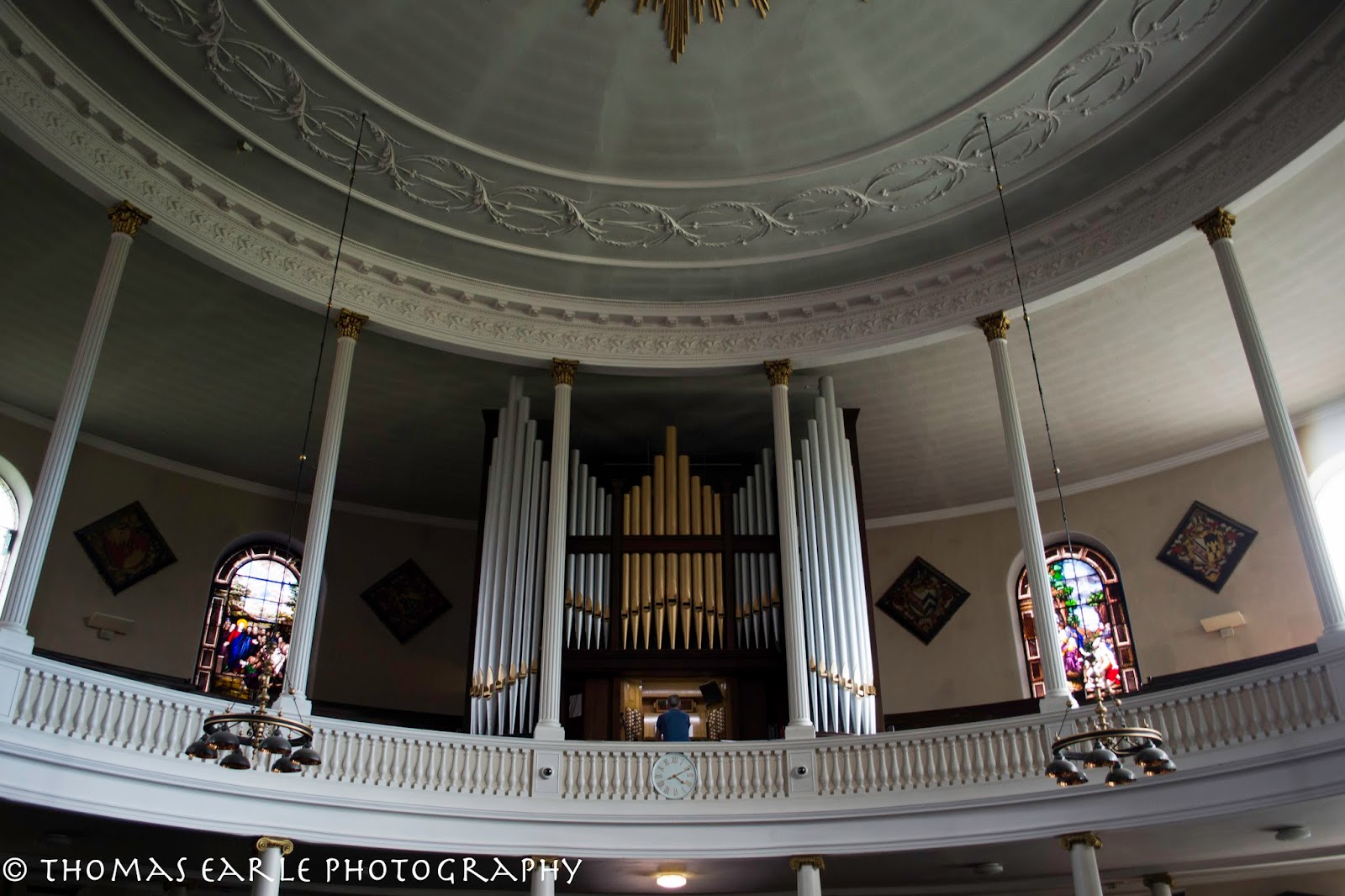
I came upon St Chad's Church, a very distinct church with a high bellower and a round shape for the body of the church.  This version of the church was opened in 1792.  I seem to keep being exceptionally lucky in my timing, as an organist was practicing on the church's organ.  I loved the design of the church with all the pews curving in and the organ and additional seating up on the second level.  In some ways, it is reminiscent of the Red Brick Church in Deerfield, Massachusetts where I went to high school.


Unknowingly, this was my first stop on a tour of the churches of Shrewsbury.  As it was late afternoon on a Sunday, many shops and sites were closed, but I was surprised by how many church doors were still open.  For those who don't know, I have been working on a project for about three years, using long exposure methods to photograph the interior of churches.  It's a bit complicated to explain when not in person and without visual examples, but it's been absolute joy of a project and so when I see towns with many churches I get very excited.  I spend more time in churches than any other atheist I know.

Following another steeple, I came to St. Alkmund's Church, which is towards the center of Shrewsbury.  A caretaker in the church told me a little more about the history of the place and the window above the altar had been replaced fairly recently.  As he told me, it is one of the last examples of a completely painted altar window.  Most are stained glass, but there was a time when painted glass was more fashionable and the man who painted this window, Francis Eginton, was well known for his skill at painting church windows.


From the center of town I went down to the River Severn and walked along the water.  I came to the path by the English Bridge and stumbled upon this gorgeous view: the elegant stone bridge, the well-lit steeple of the United Reformed Church, and a family of swans, including five or so cygnets, swimming down the river.  The banks were particularly verdant, lined with grassy patches, flowers, bushes, and trees, including many, many willow trees dipping their branches into the river.


I crossed the English Bridge and headed towards Shrewsbury Abbey.  I knew it would be closed, but I wanted to see the exterior and find out when I would be able to go into the abbey.  I was struck by the classic red phone booths in front of the cathedral.  Two very distinct British landmarks complementing one another.


I crossed back over the bridge and walked along the river.  There were many people biking and walking as well and the evening was beautiful after the rainfall.  I came back into town and went to the Roman Catholic cathedral in Shrewsbury.  I walked in and was immediately struck by the heavy perfume of incense.  I was unsure if it was remnants from earlier in the day or part of an active service, as there were a small number of people in the church praying.  I decided to wander back out before I disturbed anyone.  I continued to walk through the medieval streets of the town center, before turning back to my hotel for a break before dinner.

Today was a very nice lesson in how, on lucky occasions, things align into a beautiful day.