Showing posts with label Royal Crescent. Show all posts

Monday, July 20, 2015

Day 24: Meandering Through Museums

Somehow, Ethan and I were both convinced that yesterday was our last day in Bath and that we'd be headed to London this morning.  We're not sure how we both got so convinced of this, but we were happy to have another day in Bath.  We used it to explore some of the various museums in the city.

We went first to Holburne Museum, which is very close to our hotel.  The museum is built in the Sydney Gardens, a favored walking spot of Jane Austen when she lived in Bath, and was later adapted to house the eclectic collection of William Holburne.  The collection now includes a collection of British painting, ceramics from Britain and abroad, silver work, including many silver spoons, art and furniture from the Low Countries, and a variety of other pieces collected from around the world.


Ethan, being a harpist, was drawn by this single-action pedal harp from the 1700s.  The harp was built by famous French piano and harp maker, Sébastian Érard.  The pianoforte behind the harp is one of a handful of Schnatz instruments left and sports bone and ivory keys.  Haydn said of Schnatz pianofortes: "...everything is better expressed on a Schnantz."


While a rather prolific collected, William Holburne made a few mistakes over the years.  This includes a "Roman" ewer discovered by the Prince of Sicily in the 1800s.  A few hints that it was a fake: 1. There was no Prince of Sicily at the time; 2. The most likely candidate for who might have been this so called "prince" was only ten at the time of the "discovery"; and 3. The ewer doesn't look Roman...at all.  William got swindled.


Though there was a large collection of silver spoons, one was easily the most interesting.  This spoon was a combination of a spoon, a fork, a pen, a toothpick, and an ear-pick.  The toothpick and ear-pick portions are lost, but the bowl of the spoon could be removed to create a fork and the finial of the spoon could be removed to reveal the pen.  A pretty swanky multitool!


Here is a photo Ethan took and edited today!  A view from Holburne Museum, looking down Pulteney Road towards the center of Bath.


We headed from the Holburne into Bath Center and visited St. John the Evangelist, a Roman Catholic church.  The church was damaged by a bomb in World War II, as part of the Baedeker Blitz which targeted culturally and historic cities in England.  Six people died (although we've seen different numbers) in the church, including the parish priest of the church.  The church was rebuilt in the same Gothic style.

We then headed to a store I spotted in my wanderings yesterday, Wool.  I have been hoping to find local, British wool while in in the U.K., but have been sadly unable to.  Even in Chester, which was a once a center of the British wool trade, I couldn't find any locally sourced yarn.  However, Wool had quite a few options from around the U.K.  Ethan and I both got some new yarn, and I finally got British wool yarn (it's from Leicester!).

After getting cream tea for our lunch, we decided to head to the museum at the Royal Crescent.  Our tickets were half-price, since the BBC was filming a cooking show in the house's kitchen.  All the other rooms were accessible, so it was quite a deal!


They had a special exhibit on dollhouses from the 18th and 19th centuries.  Sadly, photography was not allowed, but the houses were extremely impressive.  They were full miniature Georgian manor houses, full of dolls, furniture, mirrors, paintings, and even china food!

We then explored the house which is meant to represent how it looked when it was occupied by Henry Sandford at the end of the 18th century.  The house contains many of his pet interests, including astronomical equipment (Ethan tests out his telescope), scientific inventions, like a machine designed to create a spark, and curiosities from around the world. 


This pistol-looking device was used to light lamps in the parlour of the house.  It would use the spark from the flint to ignite the wick.


This snake bone necklace is in Sandford's cabinet of curiosities.  The other curiosities included things like poison darts, fulgurites, arrowheads and a tomahawk from Northern America, a dog tooth purse, and more.
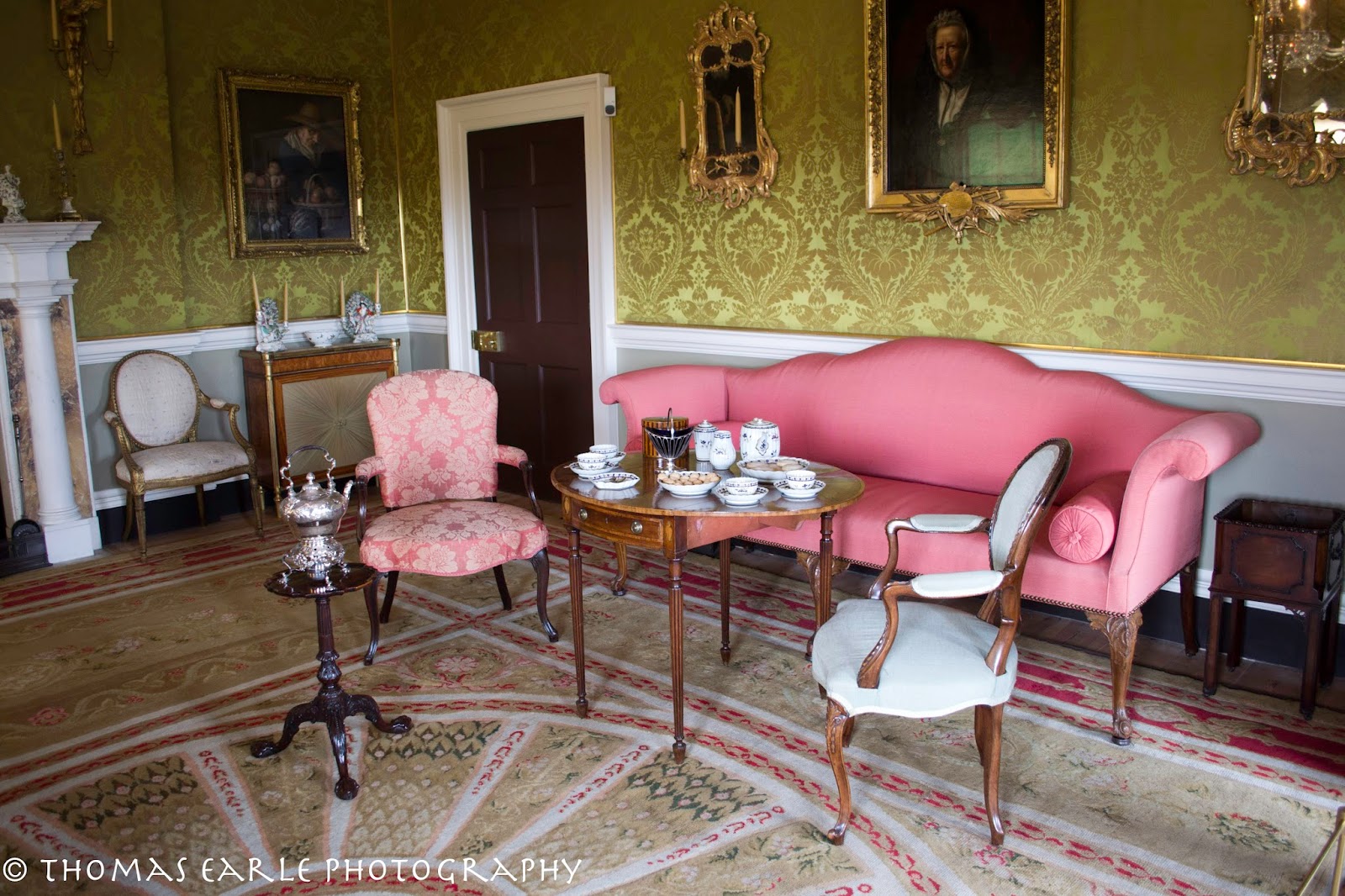

On the second floor of the house were the ladies quarters.  There was a "withdrawing" room for the women to go to after the main meal of the day.  It was set up for an after dinner tea and contained a harpsichord as well.  While the men stayed in the dining room, drinking and smoking, the women would have a quieter evening over their tea.


The other room on the second floor was the Lady's Bedroom.  The room was dominated by features to help the lady get dressed and keep her comfortable while in the many layers of clothes and wigs.  The lady of the house would have had a dedicated makeup table, holding tools to curl her hair and a wig stand for more elaborate hair pieces.  We also saw a big scratcher, as lice were apparently quite the problem in 18th century Bath.


Upstairs, the only room open to the public was the Gentleman's Bedroom.  Henry Sandford was somewhat of an invalid in his later years and spent most of his time in his bedroom.  It had a commanding view of the rest of the Royal Crescent.  The staffer in the room theorized that Sandford was quite the gossip and probably had his telescope in his room, spying on his neighbors.  He liked to write into the local papers about the raucous parties hosted in the house across the Crescent from his.

Down the servant's back staircase, we came to the humbler rooms of the house.  We were able to peak into the kitchen, despite the filming, and saw the office where the housekeeper ran the house.  Other rooms included the Servants' Hall and the Wine Vault (which was sadly not accessible to the public).  Both Ethan and I were surprised by how neat the museum was.

We then headed back to our hotel to try to escape the weather, as it was beginning to turn a bit sour.  We had a quite afternoon knitting and watching some tv (and watching the clouds roll in and out of Bath).  Now it's off for our last meal in Bath!


Fun Fact #23: In the Servants' Hall there was quite a strange contraption.  Apparently, they used a dog-powered wheel to turn the spit over the fire.  I thought it was a joke at first, but apparently, the servants would put a dog in the wheel up above the floor and through a series of ropes and pulleys, it turned the spit over the fire.  I really hope they gave the dog a fair share of that meat!

Saturday, July 18, 2015

Day 22: Visiting the Spa

Ethan and I had a busy first full day in Bath.  After a nice breakfast in our hotel, we headed into the center of Bath.  We decided to visit the Roman baths and museum first.


Even though we were at the bath complex relatively soon after opening, the place was PACKED.  There were so many families and tour groups that it was nearly impossible to move around.

The visit starts at viewing platforms over the main pool.  The platforms go all the way around the pool and are decorated with 19th century statues of Roman emperors, governors of Britain, and generals.  These include Julius Caesar, who led the first Roman incursion into Britain, Claudius, who ordered the large scale invasion of Britain, and Julius Agricola, a Roman governor of Britain known for subjugating and Romanizing the province.


The bath complex was built in a Roman town called Aquae Sulis, the Waters of Sulis.  The site had been known for its natural hot springs and before Roman times, had been considered the home of a Celtic goddess, Sulis.  The Romans adapted this belief, creating the syncretism of the Sulis Minerva.  A large complex and holy site developed around these springs.  The complex contained a naturally fed pool, tradition bathing rooms, and a temple dedicated to Sulis Minerva.  Above is an employee of the museum, dressed as a Roman priest.

From the main hot springs pool, we entered the museum.  I was surprised by how much the museum, and the site in general, was dedicated to the holy area of the complex.  I think that the name Bath distracts from what I've ever heard about the site.  It's so much more than the typical Roman bathhouses I've visited.

The temple was just next to the baths.  Though it was dedicated to Sulis Minerva, there were many altars and depictions of other deities within the temple courtyard and the surrounding area.  Facing the interior courtyard were two large depictions of Sol and Luna, the Sun and the Moon.  Below is the depiction of Luna, with the crescent moon behind her.  It also seems she is holding a whip, probably to urge on the horses of her biga, a two-wheeled chariot.  Sadly, the depiction of Sol is lost.


There were altars to many and varied gods found in temple area, including those dedicated to Aesculapius, Diana, Mercury, Jupiter, and Celtic deities, like Rosmerta.  The carving below supposedly depicts Celtic mother goddesses in a triplicate form.  There was even a dedication from the tomb of a German veteran, showing that some Germanic deities were worshiped in Bath.  All of these different religions came together in this sacred area.


One of the things I was dying to see in Bath were the curse tablets found in the spring.  This practice represents another blending of Roman and British religious customs.  Traditionally, Roman curse tablets were placed in places linked to chthonic deities and crossroads, such as cracks in walls or underground, but in Bath they were pretty much exclusively thrown into the spring.  The Romans adapted to native beliefs of connections to deities, using water as the access point.

Though many curse tablets were just addressed to "the goddess" (presumably Sulis Minerva), others were dedicated to gods like Mercury and Mars.  This curse tablet is a complaint about a theft, which seems to be what most of the Bath curse tablets were about, and lists the names of possible suspects to help the gods curse the right person.


Below is a depiction of Sulis Minerva in gilt bronze.  Not much is known about the goddess Sulis before the introduction of the Romans, other than that she was worshipped in the area of the holy springs.  She may have had similar characteristics to Minerva, such as wisdom and decisions, but this is not necessarily correct.  Sadly, we'll probably never know much about the original worship of Sulis.


Through much of the museum, it was possible to see how the natural hot springs fed the main pool of the complex and how the Romans harnessed these waters.  Much of the original Roman construction remains in use, but has been adapted by later users of the baths.  Ethan very intelligently pointed out that the areas around the spring were covered in rust, as the water is high in iron content (We can both attest to this, as they had a tasting station of the spring water.  It tasted eerily like blood.).  The water was warm enough to be steaming and casting some heat; the water coming out of the springs can reach up to 115º F.


On either side of the main pool were more traditional Roman bathing rooms.  The baths were on a fairly large scale, much larger than the town of Aquae Sulis would have required.  This is because the holiness of the site would have drawn many to come visit the baths, much like tourists flock to it today.  Below are some of the hypocausts found beneath the floors of the heated rooms in the baths.


After we finished the baths (and escaped much of the crowds), we headed into Bath Abbey.  I believe that yesterday I called the church Bath Cathedral.  This is not accurate, although the Abbey was once a cathedral.  Bath Abbey was founded in around 675 as a convent, but was later changed to an abbey. Bath Abbey was purchased in the late 11th century and turned into the seat of diocese.  It only held this title for seventy-eight years, before the diocese seat was moved again.  The church eventually fell into disrepair.


Moves to restore the church were made as early as the 1570s, when Queen Elizabeth I personally advocated for the restoration of a grand church for Bath.  The majority of restoration to the church happened in the mid-19th century, restoring the exterior and the interior of the abbey.


The famous fan ceiling of the abbey was completed in the 1860s, but had been the brainchild of a 15th century bishop.


The organ of the abbey was replaced in 1997 with this beautiful Klais Orgelbau pipe organ.


Ethan and I wandered around more in the afternoon, including walking along the River Avon.  The picture above shows Pulteney Bridge, a Georgian addition to the city.  The bridge is lined with stores and restaurants.


We made our way up through The Circus and went to the Royal Crescent.  The Crescent is another Georgian architectural wonder of Bath.  The building was originally designed as thirty terraced homes, but now only ten remain single family homes.  Twelve have been split into apartments, one is a museum for the Crescent, and one is a hotel.

With many of the maps of Bath we've collected, Ethan and I have found many options for discounts for food and beverages.  Sadly, none seemed to be available on a Saturday night.  But we did have a lovely restaurant at a French restaurant.  We seem to be taking a tour of Mediterranean cuisine!

Fun Fact #22: In the bath complex, there is a depiction of a legendary King of the Britons, Bladud.  He has no basis in history, but seems to have been a creation by Geoffrey of Monmouth.  On top of founding Bath (in the 9th century CE), he is credited with being educated in Athens and founding a university in England that was later suppressed by Augustine of Canterbury.  Seems like a busy (fictional) guy!